
Would you willingly hand over a $48,000 check to the court system just for the privilege of settling your loved one's estate? For many California families, this isn't a choice but a mandatory consequence of not knowing exactly when is probate required. It's frustrating to realize that even a simple Will doesn't stop the clock on a 12 to 18 month court process or keep your private family business out of public records. You likely feel a sense of urgency to protect your inheritance from statutory fees that eat away at the equity your family worked so hard to build.
I understand the anxiety that comes with navigating the confusing $208,850 small estate limit and the fear of losing control to a slow legal system. This guide will show you exactly which assets trigger a formal probate and how new 2026 laws, including the $750,000 primary residence shortcut, can help your family transfer property quickly and privately. We'll walk through the specific steps to determine if you can avoid court entirely and secure your family's legacy without the heavy burden of unnecessary legal costs.
Key Takeaways
- Identify the specific asset types and ownership structures that determine exactly when is probate required under California law.
- Master the new $208,850 small estate limit to see if your family can use simplified transfer procedures instead of a full court case.
- Explore the upcoming 2026 legislation that allows primary residences valued up to $750,000 to bypass the traditional probate timeline.
- Learn how to protect your family’s privacy by avoiding the public nature and long delays of the local court system.
- Discover how a properly structured plan acts as a shield against the high statutory fees that often drain local estate values.
Understanding Probate: When Does the California Court Step In?
Think of probate as the court-supervised "cleanup" process. When you begin Understanding Probate, it's easiest to view it as a formal system designed to prove a Will is valid, pay off any remaining debts, and eventually distribute assets to heirs. In California, this process is the default setting for anyone who hasn't specifically planned to avoid it. Knowing when is probate required is the first step in protecting your family from a process that is often slow, expensive, and entirely public.
The court generally steps in when a person dies owning assets in their name alone. If there isn't a legal mechanism in place to transfer the title, a judge must sign an order to move that asset to the next person. While items like life insurance or 401k accounts with designated beneficiaries usually skip the courtroom, other assets don't have that luxury. In San Jose and throughout the South Bay, Silicon Valley homes are the most common reason families find themselves in probate court. Because real estate values here are so high, even a modest family home can trigger a mandatory court process and the high fees that come with it.
Sole Ownership vs. Joint Ownership
Many people believe that holding property in "Joint Tenancy" is a clever way to bypass the system. While it's true that the property passes to the surviving owner without court intervention at first, this often creates a "tax trap" by losing valuable tax breaks on capital gains. Eventually, when the second owner passes away, the property will still end up in court. Assets that typically trigger the need for a judge include real estate, bank accounts without a "Payable on Death" (POD) instruction, and valuable personal property.
The "Will" Misconception
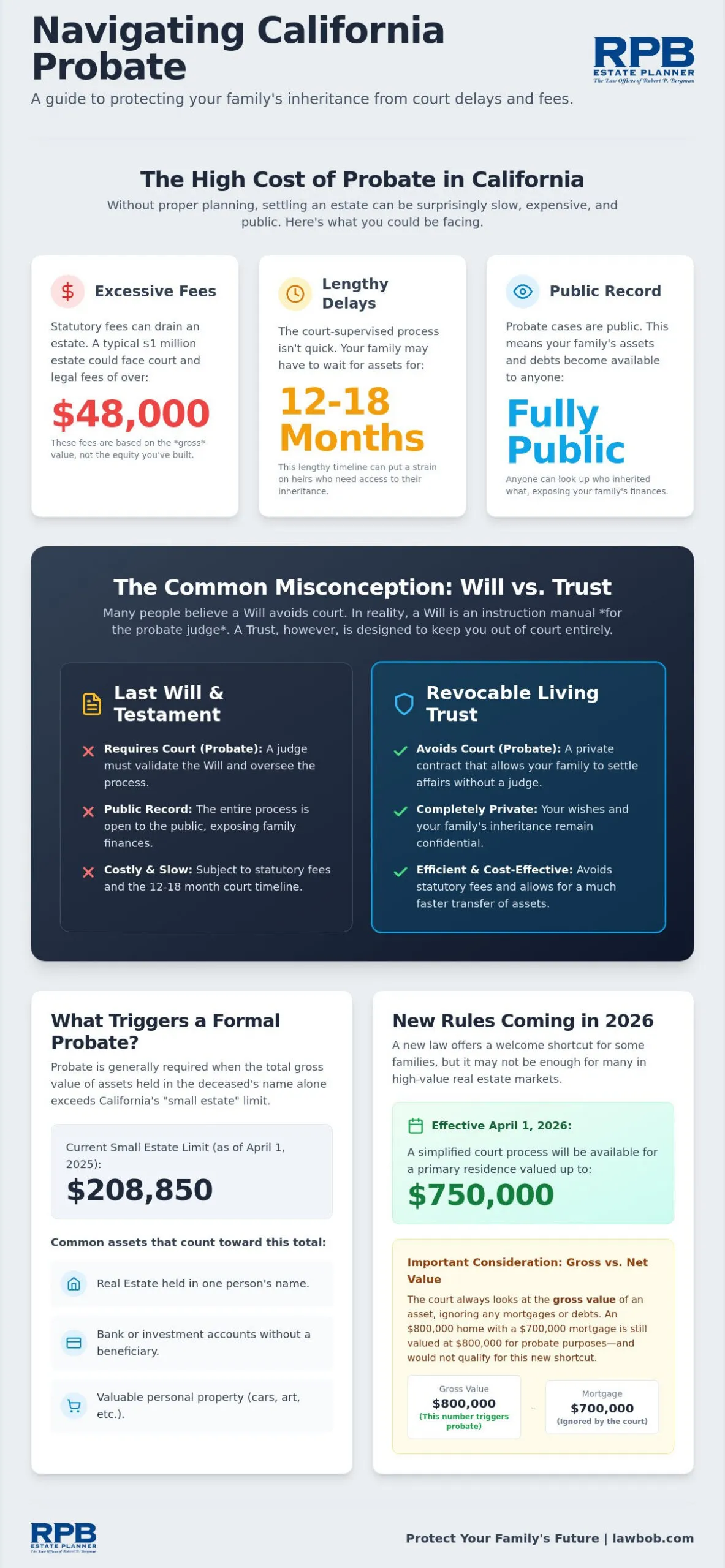
One of the biggest surprises for my clients is learning that having a Will doesn't keep you out of court. A Will is essentially a formal letter to a probate judge explaining your final wishes. It still requires the court to oversee the distribution. In contrast, a Revocable Living Trust acts like a private contract. It allows your family to handle your affairs behind closed doors, avoiding the 12 to 18 month delay and the $48,000+ in statutory fees often found with a $1 million estate.
California Small Estate Limits and the New 2026 Rules
California law provides a "small estate" shortcut, but the rules are specific and change often. If you're trying to figure out when is probate required, the total value of the assets is usually the deciding factor. For deaths on or after April 1, 2025, the threshold to use a simplified affidavit process for personal property is $208,850. This allows heirs to collect bank accounts or other funds without a judge's signature. You can find more details on these specific thresholds in the California Courts Probate Guide.
There's a significant change coming on April 1, 2026. A new law will allow primary residences valued up to $750,000 to qualify for a simplified transfer petition. While this is a welcome relief for many, it's often a tight fit for San Jose residents. With local property values frequently crossing the million dollar mark, many families still find themselves pushed into formal court territory simply because their homes are worth more than the state's "small" definition.
How to Calculate Your Estate Value
The court looks at "gross value" rather than "net value." If a home is worth $900,000 but has an $800,000 mortgage, the court still treats it as a $900,000 asset for its calculations. Your debts don't reduce the total for the purpose of triggering probate. To estimate your estate value, total up these items:
- Real estate market value (ignore the mortgage balance).
- Bank accounts and stocks without named beneficiaries.
- Vehicles and personal belongings.
- Business interests or uncollected debts owed to the deceased.
Simplified Procedures for Spouses
Surviving spouses often have a simpler path. A Spousal Property Petition can transfer assets to a husband or wife much faster than a standard case. Couples who hold their home as community property with right of survivorship often avoid court entirely for that specific asset. If you're facing these decisions now, looking into professional probate administration can help you determine the most efficient route for your situation.
How to Settle an Estate Without Court (and Why You Should)
Settling an estate in Santa Clara County isn't just a legal chore; it's a public event. Because probate records are open to anyone, your family's financial details and home address become part of the public record for months. Beyond the loss of privacy, the timeline is often exhausting. Local courts are frequently backlogged, meaning a standard case can easily stretch to 18 months. During this time, assets are often frozen, making it difficult for heirs to pay bills or sell property.
Understanding exactly when is probate required helps you see why avoiding it is the smarter financial move. California sets statutory fees that are surprisingly high. On a typical $1 million Silicon Valley home, the combined fees for the attorney and the executor can exceed $48,000. This money comes directly out of the inheritance that should have gone to your children or spouse. A Revocable Living Trust keeps these matters private and keeps that money in your family's pocket.
The Heggstad Petition: A "Safety Net" for Trusts
Even if you have a trust, mistakes happen. Sometimes people forget to transfer their house title into the trust's name. This is a common trigger for when is probate required, but there is a specific solution known as a Heggstad Petition. Under Probate Code Section 850, we can often ask a judge to declare that an asset belongs in the trust even if the paperwork wasn't finished. A Heggstad Petition is a way to "retroactively" fund a trust after death, saving your family from a full, year-long probate process.
Taking the Next Step in San Jose
Don't leave your family's security to the default court process. Review your current estate blueprint with a Certified Specialist to ensure your plan is airtight and up to date with 2026 laws. There is immense peace of mind that comes from knowing your family is protected from court delays and unnecessary fees. Taking action now ensures that your legacy is handled with the precision and privacy your family deserves.
Take Control of Your Legacy Today
Protecting your family from the public nature and high costs of the California court system starts with a clear strategy. You've learned that high property values in Silicon Valley often trigger a mandatory court process, but you've also seen how new 2026 laws and tools like the Heggstad Petition offer a way out. Understanding exactly when is probate required gives you the power to act before a crisis occurs. This ensures your assets pass to your loved ones without the 12 to 18 month delay typical of local courts.
As a Certified Specialist in Estate Planning, Trust & Probate Law with over 40 years of experience in the San Francisco Bay Area, I'm here to help you design a blueprint that works. Whether you need to fix an unfunded trust or build a new plan from scratch, my fixed-cost service model provides the financial predictability you deserve. Schedule a consultation with Robert P. Bergman to review your options and keep your family out of court. You've worked hard for what you have; with the right preparation, you can rest easy knowing your legacy is safe and secure.
Frequently Asked Questions
Is probate required if there is a Revocable Living Trust?
No, assets held in a properly funded Revocable Living Trust do not go through court. The trust acts as a private contract that allows your successor trustee to transfer property directly to your heirs. However, if you forget to title an asset in the trust's name, your family might still face the question of when is probate required for those specific items.
Can I avoid probate in California without a trust?
Yes, you can use several tools like joint tenancy with right of survivorship or "Payable on Death" designations for bank accounts. These methods allow assets to transfer automatically to a co-owner or beneficiary. While these options work for simple situations, they don't offer the same tax protections or long-term control as a trust, especially for real estate.
How much does probate cost for a $1 million home in San Jose?
For a $1 million home, the combined statutory fees for the attorney and executor typically exceed $48,000. California law sets these fees based on the gross value of the property, not the equity. Even if the home has a large mortgage, the fees are calculated on the full $1 million market value, which is why local families often seek ways to avoid court.
What is the "Small Estate" limit in California for 2026?
For deaths occurring on or after April 1, 2025, the threshold for personal property is $208,850. Additionally, a new rule starting April 1, 2026, allows a simplified petition for primary residences valued at $750,000 or less. If the total estate value stays below these specific limits, your family can often use a simplified process instead of a full probate case.
How long does the probate process take in Santa Clara County?
The average probate case in Santa Clara County takes between 12 and 18 months to complete. Simple estates might finish in a year, but court backlogs and complex asset distributions can push the timeline much further. During this period, the estate is under court supervision, and most assets cannot be sold or distributed without a judge's approval.
Do I need a lawyer for probate if the estate is small?
You aren't legally required to hire a lawyer for small estate procedures, but it's often helpful to ensure the paperwork is filed correctly. Even with simplified affidavits, mistakes can lead to frozen accounts or rejected filings. Consulting with an expert helps you confirm exactly when is probate required and ensures you aren't accidentally triggering a more complex court process than necessary.