That $150 online trust you just bought might be the most expensive mistake your family ever makes. While it feels like a win to save on legal fees, the limitations of DIY estate planning software often leave California families exposed to the very risks they were trying to avoid. It's a common trap where a small savings today leads to a $46,000 probate bill for your children tomorrow. We understand that you want to protect your legacy without getting buried in complex legal jargon or high costs. It's natural to feel overwhelmed by California-specific rules like Proposition 19 or the newly reinstated Medi-Cal asset limits that went into effect this year.
You deserve to know that your hard work won't be lost to the state's statutory probate fees or tied up in court for 18 months. This article explains why "cheap" online tools often fail to protect your family and how you can secure a plan that actually works. We'll look at the specific legal gaps in automated software and provide a clear path to ensuring your assets transfer quickly and safely to the people you love. You will learn how to avoid the common pitfalls of unfunded trusts and how to protect your children from creditors or future divorces.
Key Takeaways
- Understand why the low upfront price of online forms often masks massive future costs for your heirs.
- Learn the specific limitations of DIY estate planning software when it comes to California-specific laws like property tax reassessments under Proposition 19.
- Discover the danger of an "unfunded trust" and how to ensure your home actually stays out of the probate court.
- See how a professional "architect" approach builds a protective shield around your children's inheritance to guard against creditors or divorce.
- Gain a clear roadmap for avoiding the 5% statutory probate fee and ensuring a fast, private transfer of your assets.
What is DIY Estate Planning Software (And Why Is It So Popular?)
DIY estate planning software refers to automated platforms that allow you to generate legal documents like Wills or Revocable Living Trusts by answering a series of online prompts. These tools are popular because they offer immediate results and a low initial price tag. It's easy to see why someone would choose this path; you can complete your forms in an afternoon without leaving your couch. However, there is a fundamental difference between a "document mill" that spits out generic forms and a custom-tailored legal plan designed by a professional.
To understand the full scope of What is Estate Planning, you have to look beyond the paper. A true plan is a strategy for your life and legacy. One of the primary limitations of DIY estate planning software is that the program can only answer the questions it's coded to ask. It can't look at your family dynamics, spot potential tax traps, or warn you about specific California laws that might trigger an expensive court process later. Software is a tool for drafting, but it isn't a substitute for legal advice.
Software platforms serve as digital document mills that focus on the mechanical act of printing a form. They lack the defensive strategy required to protect a California estate in 2026. While the software might help you list your assets, it won't provide the mentorship needed to navigate a sudden change in law or a complex family situation. This is where the limitations of DIY estate planning software become dangerous; the user often doesn't know what they don't know until it is too late for their heirs to fix it.
The "One-Size-Fits-All" Trap
Most online platforms are built to satisfy general requirements across all 50 states. This broad approach often fails to meet the strict standards of the California Probate Code. For example, local court nuances in Santa Clara County can lead to a judge rejecting a document that looked perfectly fine on your computer screen. When you use a template, you're betting that a generic form will hold up against complex state-specific regulations. These templates don't account for the unique way California handles property or the specific language required to keep your family out of a public courtroom.
5 Critical Limitations of DIY Estate Planning for California Families
While clicking "print" on a digital form feels satisfying, the reality of California law is far more complex than a basic algorithm can handle. Many families believe they've secured their future, only to leave behind a mess that requires expensive court intervention. These limitations of DIY estate planning software often appear at the worst possible time, long after the documents were signed. Here are five ways these tools typically fail California residents.
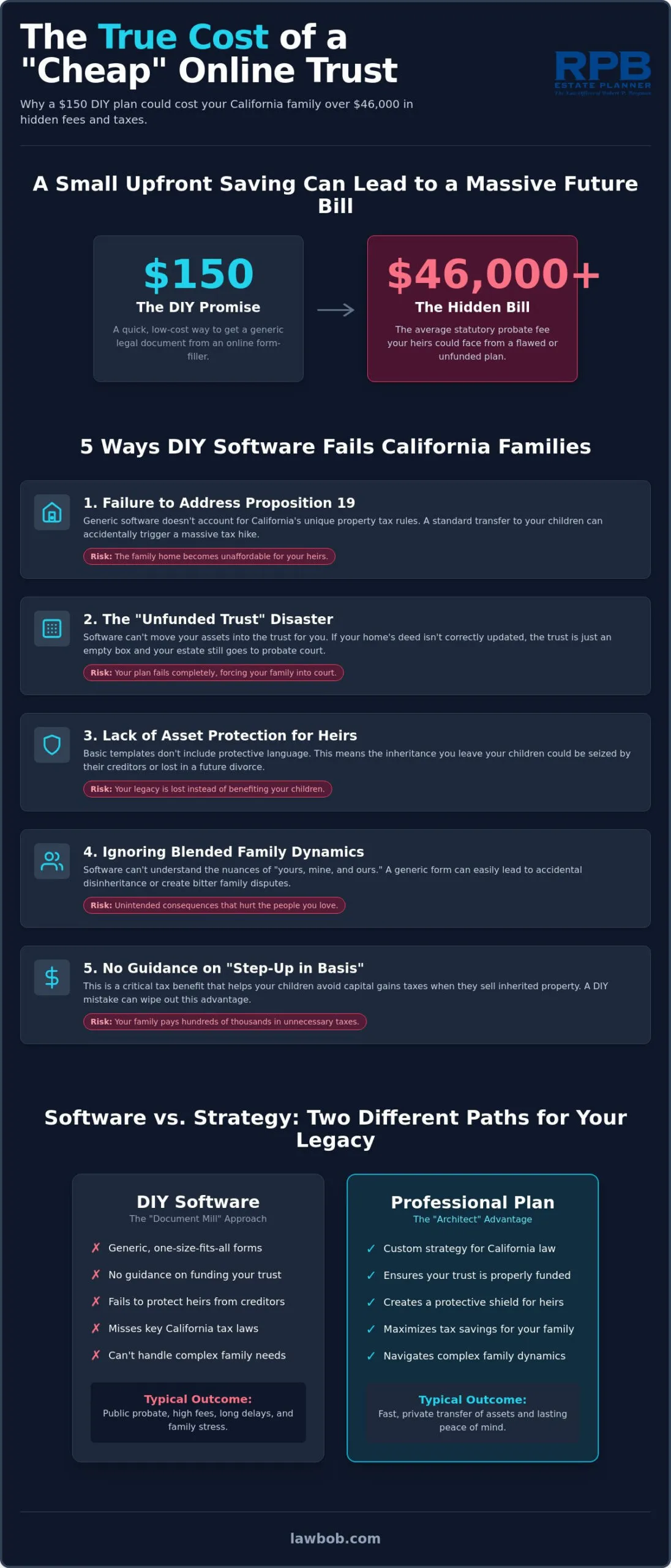
- Failure to Address Proposition 19: Most generic software doesn't account for California’s unique property tax reassessment rules. If you transfer your family home to your children using a standard template, you might accidentally trigger a massive property tax hike that makes the house unaffordable for them to keep.
- The "Unfunded Trust" Disaster: A trust is like a safe, but it only works if you put your valuables inside. Software platforms won't move your San Jose home or your bank accounts into the trust for you. If your deed isn't updated to show the trust as the owner, your estate will likely end up in probate court anyway.
- Lack of Asset Protection: Basic templates rarely include specialized language to protect your heirs. Without specific "Castle Trust" provisions, the inheritance you leave your children could be seized by creditors or lost in a future divorce.
- Ignoring Blended Family Dynamics: Software struggles with the nuances of "yours, mine, and ours." If you have children from a previous marriage, a generic form can easily lead to accidental disinheritance or long inheritance disputes.
- No Guidance on "Step-Up in Basis": This is a critical tax benefit that allows your children to avoid capital gains taxes when they sell your home. A DIY mistake here can cost your family hundreds of thousands of dollars in unnecessary taxes.
Many people turn to online will services to save money, but they often overlook the long-term financial consequences. If your plan doesn't meet specific legal standards, your family may need to file a Heggstad Petition to ask a judge to recognize your trust, which adds extra stress and legal costs during an already difficult time.
The Hidden Cost of "Cheap" Documents
In 2026, the cost of a failed DIY plan is staggering. Under California law, probate fees are calculated based on the gross value of your estate, not what you actually own after debt. For a $1 million home in the Bay Area, the combined statutory fees for the attorney and the person handling the estate are approximately $46,000. This is a massive bill that could have been avoided with a properly drafted plan. If you want to ensure your assets are protected without these surprise costs, consider a professional review of your Revocable Living Trusts.
Property Tax Traps in the Bay Area
Local expertise is vital in Santa Clara County, where property values are high. A DIY trust can easily trigger a property tax reassessment if it isn't structured to comply with current state laws. Keeping your tax base low requires precise language that generic software simply doesn't provide. Protecting your family’s financial security means more than just filling out a form; it requires a strategy that guards against both taxes and court interference.
The "Architect" Advantage: Why Professional Guidance Outperforms Software
Imagine trying to build a custom home in San Jose without a blueprint. You might have the best tools in the world, but without a design, the structure won't stand against the next earthquake. This is the difference between an automated program and a seasoned attorney. While the software is merely a tool like a hammer, a Certified Specialist in Estate Planning, Trust, and Probate Law acts as the architect. They don't just hand you a stack of papers; they design a defensive strategy that aligns with your family goals and local California regulations.
A primary limitation of DIY estate planning software is that it lacks the foresight to ensure your plan actually works when it matters most. Professional guidance focuses on a "fully funded" approach, making sure your home and accounts are properly titled in the name of your trust. Without this essential step, your documents are effectively useless. We also offer specialized protections like the Children’s Legacy Plan, which creates a protective shield around your children's inheritance to guard against creditors or divorce. By addressing potential estate planning mistakes during the design phase, you gain the peace of mind that comes from a plan built to last.
Beyond the Documents: Trustee Advisory Services
A legal plan is only effective if the people you leave in charge know how to use it. Our San Jose firm provides ongoing mentorship through Trustee Advisory Services to support the people you've chosen to manage your affairs. We guide your trustees through the complex steps of trust administration so they don't feel overwhelmed by the legal responsibility. This human connection is one of the many limitations of DIY estate planning software; a computer program won't be there to comfort or guide your family when you are gone.
Planning for Disability, Not Just Death
Effective planning also protects you while you are still here. Custom Powers of Attorney and Advance Health Care Directives ensure your personal wishes are followed if you ever become unable to make your own decisions. Without these specific instructions, your family might be forced into a "living probate" known as a Conservatorship. This is a public, expensive, and often stressful court process that can be avoided with the right blueprint. To protect your independence and your family's privacy, Schedule a consultation with Bob Bergman to build your custom blueprint.
Secure Your Family's Future Today
Your family's legacy is too important to leave to a generic algorithm. We've explored why the limitations of DIY estate planning software often lead to "unfunded" trusts and missed property tax protections. Instead of a one-size-fits-all form, you need a blueprint that accounts for California's unique legal landscape. A document is just paper; a plan is a promise that your children will be taken care of according to your exact wishes.
Robert P. Bergman brings over 40 years of experience as a State Bar of California Certified Specialist to every plan he creates. As the host of "Plan Your Estate Radio" on KDOW AM 1220, he's dedicated to helping families avoid the $48,000 or more in probate costs that follow failed DIY attempts. You don't have to navigate these complex decisions alone. Take the first step toward true security by building a plan that actually works when your family needs it most. Protect your family with a custom blueprint from a San Jose Certified Specialist. You've worked hard for what you have; let's make sure it stays in the right hands.
Frequently Asked Questions
Can I just use a DIY will if I only have a small estate in California?
Yes, you can use a DIY will for a small estate, but you must follow California's specific legal definitions. As of 2026, the threshold for avoiding formal probate is $208,850 for assets that are not real estate. This is one of the common limitations of DIY estate planning software; it doesn't always explain that owning a home changes the rules. If you own a house, a simple will usually won't keep your family out of court.
What happens if my DIY trust is not "funded" with my San Jose house?
Your trust will fail its primary purpose if it isn't "funded" with your San Jose home. This is another one of the major limitations of DIY estate planning software because digital tools cannot record a new deed at the county office for you. If the house stays in your name, your heirs will likely have to file an expensive Heggstad Petition or go through full probate to transfer the property.
Is a DIY power of attorney valid in California hospitals?
Yes, a DIY power of attorney is technically valid in California if it meets specific signature and notary requirements. However, hospitals and banks often reject generic forms that lack precise language. If a facility refuses to honor your document, your family might have to seek a court-ordered conservatorship to manage your affairs. Using a professional Advance Health Care Directive ensures your medical wishes are accepted immediately during a crisis.
How much does it cost to fix a mistake in a DIY estate plan later?
Fixing a mistake after you pass away can cost your family tens of thousands of dollars in court fees. If a DIY error triggers full probate, the statutory fees for a $1 million estate are approximately $46,000 in 2026. It's much more cost-effective to invest in a reliable blueprint now than to leave your children with a massive legal bill that could have been avoided with professional guidance.