
In the high-stakes environment of Silicon Valley, being named a successor trustee often feels less like an honor and more like an unexpected second job with serious legal consequences. You might be searching for a trust administration lawyer because you've realized that managing a family estate involves much more than just reading a will. It's common to feel a sense of dread about making a financial mistake; especially when dealing with California's complex property tax laws like Prop 19 or the pressure of keeping family peace during asset distribution.
You deserve to handle these responsibilities without the constant fear of personal liability or the stress of legal uncertainty. This guide provides the clear roadmap you need to navigate the administration process with confidence, ensuring you protect your family's inheritance and honor your loved one's legacy. We'll walk you through the essential steps to manage the trust legally, minimize tax obligations, and keep the estate out of probate court. This approach gives you the peace of mind that comes from knowing every detail is handled correctly and with the precision your family deserves.
Key Takeaways
- Define your role as the "manager" of the trust and understand why this private process is a preferred alternative to probate court.
- Follow a step by step roadmap for 2026 that covers essential tasks like asset valuation and the proper sequence for paying taxes.
- Partner with a trust administration lawyer who serves as your professional architect, helping you avoid common financial pitfalls and family conflict.
- Learn about the 2026 California probate thresholds and whether the estate qualifies for a more streamlined distribution process.
Understanding Trust Administration: Your Role as a Successor Trustee
Stepping into the role of a successor trustee often feels like taking on a second career without any training. Understanding Trust Administration is the first step toward success. This is the private process of wrapping up a loved one’s affairs without the interference of a probate court. You are essentially the manager of the trust’s assets and instructions. While it's okay to feel the weight of this responsibility, remember that a qualified trust administration lawyer can provide the guidance needed to move forward with confidence. Because this process is private, you won't have a judge watching every move, which offers flexibility but also places a heavy burden of responsibility on your shoulders.
The Immediate Checklist: What Happens First?
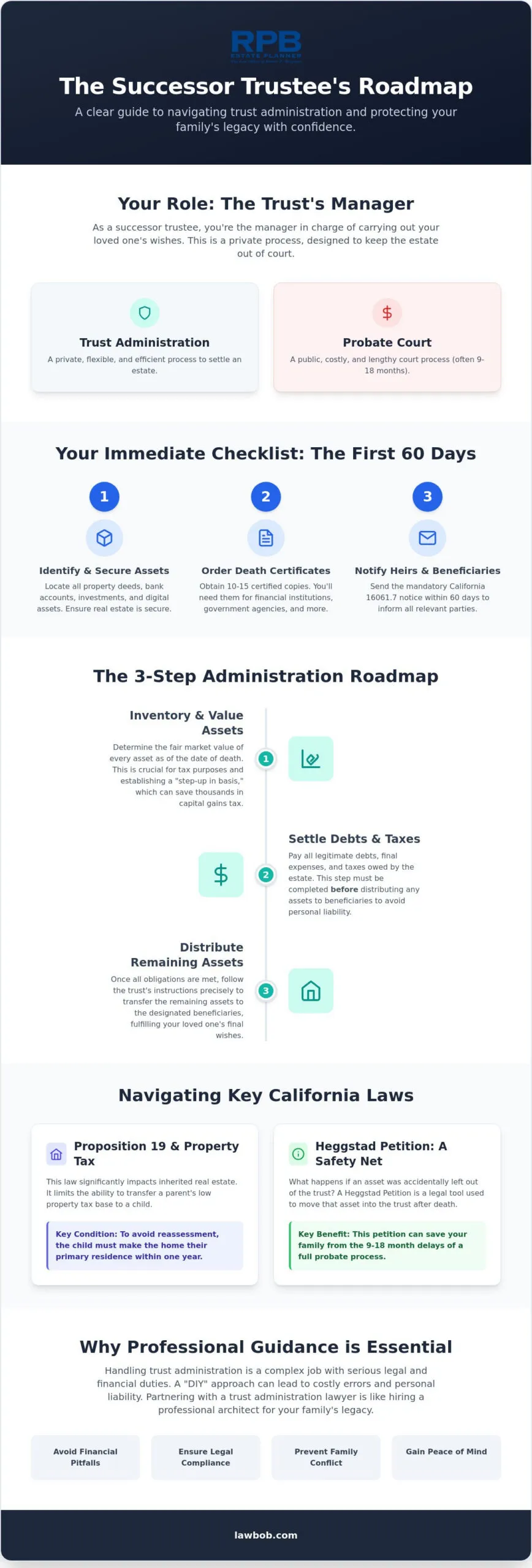
Take the first few steps correctly to set the tone for the entire process. Start by identifying and securing all trust assets. In Silicon Valley, this often includes high-value San Jose real estate or complex investment portfolios. You'll also need to order at least ten to fifteen copies of the death certificate; you’ll need them for everything from closing utility accounts to transferring titles. Finally, California law requires you to send a formal notice to all beneficiaries and heirs. This is known as a 16061.7 notice, and it must be done within 60 days of the trust becoming irrevocable.
- Identify Assets: Locate bank accounts, property deeds, and digital assets.
- Secure Property: Ensure real estate is locked and insurance is current.
- Notify Parties: Send mandatory legal notices to heirs and beneficiaries.
Why "DIY" Trust Administration is Risky
It’s tempting to try and handle everything yourself to save money, but trust administration is not a simple weekend project. Even a minor error in how you phrase a title transfer or a missed tax filing deadline can lead to personal liability. Think of it like this: you wouldn't attempt to perform brain surgery on yourself just because you have the tools. Your family's legacy is too important to risk on a "do it yourself" approach. Working with a trust administration lawyer ensures that the plan is executed safely, shielding you from legal disputes and financial mistakes. This professional support allows you to focus on your family while we handle the technical details.
The Successor Trustee Roadmap: Navigating the Process in 2026
Once you've secured the assets, you need a clear plan to move forward. The Successor Trustee Roadmap begins with a thorough inventory. You must determine the fair market value of every asset as of the date of death. This isn't just for record-keeping; it's vital for the "Step-Up in Basis" rule. In high-value areas like San Jose, this rule is a massive benefit. It resets the property's value for tax purposes to its current market price, potentially saving your family hundreds of thousands of dollars in capital gains taxes when the asset is eventually sold.
After valuation, your next duty is to satisfy all debts and taxes. You must ensure the IRS and any valid creditors are paid before any funds reach the beneficiaries. If you distribute money too early, you might find yourself personally responsible for the deceased person's unpaid bills. A skilled trust administration lawyer can help you verify which claims are legitimate and ensure your filings are accurate. Finally, you move to asset distribution, where you follow the trust's instructions like a blueprint to transfer property to the rightful heirs.
The Heggstad Petition: Saving an Unfunded Trust
Sometimes, a loved one forgets to finish the job, leaving a primary residence or bank account out of the trust. A Heggstad Petition is a legal tool used to move assets into a trust after death without requiring a full probate process. Under Probate Code 850, we can often ask the court to honor the deceased person's intent if there is written evidence they meant for the asset to be included. This specialized filing acts as a safety net, saving your family from the 9 to 18 month delay typical of Santa Clara County probate cases.
Proposition 19 and California Real Estate
In 2026, Proposition 19 continues to be a major factor for families in Santa Clara County. This law strictly limits the ability to pass on a parent’s low property tax base to their children. Unless the child makes the home their primary residence within one year, the property will likely be reassessed at its current, much higher market value. Consulting with a trust administration lawyer can help you explore options for strategies that might mitigate these costs and preserve your family's financial security.
Professional Support: Why a San Jose Trust Lawyer is Essential
Navigating the legal requirements of an estate in 2026 requires understanding specific financial triggers. For example, California law now allows for simpler paths if personal property is under $208,850 or if a primary residence is valued up to $750,000. While these thresholds might sound straightforward, miscalculating values can accidentally push an estate into a full probate process. This is where a trust administration lawyer acts as the architect of your plan. You, as the trustee, are the contractor executing the work, but you need a solid set of blueprints to ensure you aren't building on shaky ground. By working with a Certified Specialist in Estate Planning, Trust, and Probate Law, you ensure that the distribution is fast, inexpensive, and free from the family conflict that often arises when instructions are unclear.
Protecting the Next Generation
Asset distribution isn't just about handing over a check. You may need to protect a beneficiary's inheritance from future risks they haven't encountered yet. We often use tools like "The Castle Trust" to shield assets from a beneficiary’s future divorce or potential creditors. Additionally, if a loved one has a disability, a Special Needs Trust is essential. This ensures their inheritance provides for their comfort without accidentally disqualifying them from vital government benefits. These specialized structures provide a safety net that lasts long after the initial administration is complete.
Your Next Steps with Bob Bergman
Your role as a trustee is manageable when you have the right support. Schedule a consultation with a trust administration lawyer to review your trust blueprint and ensure you're meeting every legal requirement. You can also listen to the "Plan Your Estate Radio" show for more insights into protecting your family legacy. By taking these steps, you move from a place of uncertainty to a position of strength and clarity. Taking action now prevents small errors from turning into expensive legal headaches later.
Protect your family’s legacy—schedule a trust administration consultation with Bob Bergman today.
Take Control of Your Legacy Today
Successor trusteeship is a significant responsibility, but it doesn't have to be a source of constant stress. You now have a clearer understanding of your role as a manager, the importance of accurate asset valuation, and the technical strategies available to keep your family out of probate court. By following this roadmap, you can honor your loved one's wishes while protecting the inheritance of the next generation.
Working with an experienced trust administration lawyer ensures that you fulfill your legal duties without risking personal liability or family conflict. Robert P. Bergman has been practicing in California since 1980 and is a Certified Specialist in Estate Planning, Trust and Probate Law. As the host of "Plan Your Estate Radio," he is dedicated to educating families and providing the steady hand needed to navigate Silicon Valley's unique property and tax laws.
Secure your family’s future; contact the Law Offices of Robert P. Bergman for a consultation. You've already taken the first step by getting informed. Now, let's work together to ensure your family's assets are protected and distributed exactly as intended.
Common Questions About Trust Administration
How much does trust administration cost in California?
Most California trust administrations cost between $3,000 and $15,000 in professional fees and expenses. This range depends on the complexity of the assets and whether there are any disagreements among heirs. While this is an investment, it's often much less than court-supervised probate fees. For a $1.5 million estate in Santa Clara County, probate fees for an attorney and executor can reach approximately $56,000.
How long does the trust administration process take?
A typical trust administration takes between six months and one year to complete. This is significantly faster than the 9 to 18 months usually required for probate in Santa Clara County. The timeline varies based on how quickly you can value assets, whether you need to sell real estate, and if you must wait for specific tax clearances from the IRS before distributing funds.
Can a trustee be held personally liable for mistakes?
Yes, a successor trustee can be held personally liable if they fail to follow the law or the trust's instructions. For example, failing to notify the local Child Support Director within 90 days about a beneficiary's status can create personal financial risk. Partnering with a trust administration lawyer helps you avoid these pitfalls by ensuring every legal notice and tax filing is handled correctly and on time.
Is a Heggstad Petition necessary if I have a Will?
A Heggstad Petition is necessary if an asset was intended for the trust but was never officially transferred, regardless of whether you have a Will. While a "Pour-Over Will" catches assets left out of the trust, it typically forces them through the probate court. A Heggstad Petition allows your trust administration lawyer to ask the court to move that property directly into the trust, avoiding lengthy court delays.