
Table of Contents
- Why Real Estate Trust Funding Matters for California Families
- The DIY Transfer Approach: Common Mistakes and Hidden Costs
- Our Professional Trust Funding Process: Accuracy and Peace of Mind
- Comparing Timeline and Efficiency: Speed to Protection
- Comparing Legal Compliance: State Requirements and Documentation
- Comparing Long-Term Asset Protection: Peace of Mind vs Risk
- Why Professional Guidance Prevents Costly Errors
- How We Handle Complex Property Situations
- The Hidden Costs of Getting It Wrong
- Our Comprehensive Trust Administration Support
- Why Working With Us Is Your Best Choice
- Next Steps: Schedule Your Trust Funding Consultation
Why Real Estate Trust Funding Matters for California Families
Your home is likely your largest asset. Without proper trust funding, it could end up in probate court instead of smoothly passing to your heirs. We see this scenario play out regularly: families who thought they had everything handled discover their real estate wasn’t actually titled in their trust when the time comes.
Trust funding means officially transferring ownership of your property into your living trust’s name. It sounds straightforward, but California has specific requirements about how this transfer must happen legally and tax-efficiently. When your property sits in your individual name rather than your trust, probate becomes inevitable. That means months of court proceedings, public disclosure of your assets, executor fees, and attorney costs that could drain 3-7% of your estate’s value.
The right approach protects your family from probate, maintains privacy, and ensures your property transfers exactly as you intended. Getting it wrong can create tax complications, title issues, or worse, invalidate your trust’s protections entirely.
The DIY Transfer Approach: Common Mistakes and Hidden Costs
Many California families attempt to fund their own trusts using online templates or vague instructions. Here’s what typically goes wrong:
Incorrect deed language. A standard grant deed may not properly reflect trust ownership. We’ve reviewed documents where people used the wrong deed type entirely, creating title ambiguity that later required expensive court intervention.
Missing beneficiary language. Your trust document must clearly identify beneficiaries and successor trustees. Without precise language linking your deed to your trust’s specific terms, transfer errors become likely.
Title insurance complications. Many title companies won’t insure properties transferred with improper documentation. You could face a title defect years later when selling or refinancing, with no insurance protection.
Missed recording requirements. California requires your deed be properly recorded in Santa Clara County (or your county) with the correct legal description, trust information, and signatures. One missing element delays or invalidates the transfer.
Tax reporting oversights. While trust funding shouldn’t trigger reassessment under California’s Proposition 13, incorrect paperwork can trigger unexpected property tax bill increases.
DIY attempts often save a few hundred dollars upfront but create liability exposure worth thousands later. We recommend treating this as the high-stakes document it truly is.
Our Professional Trust Funding Process: Accuracy and Peace of Mind
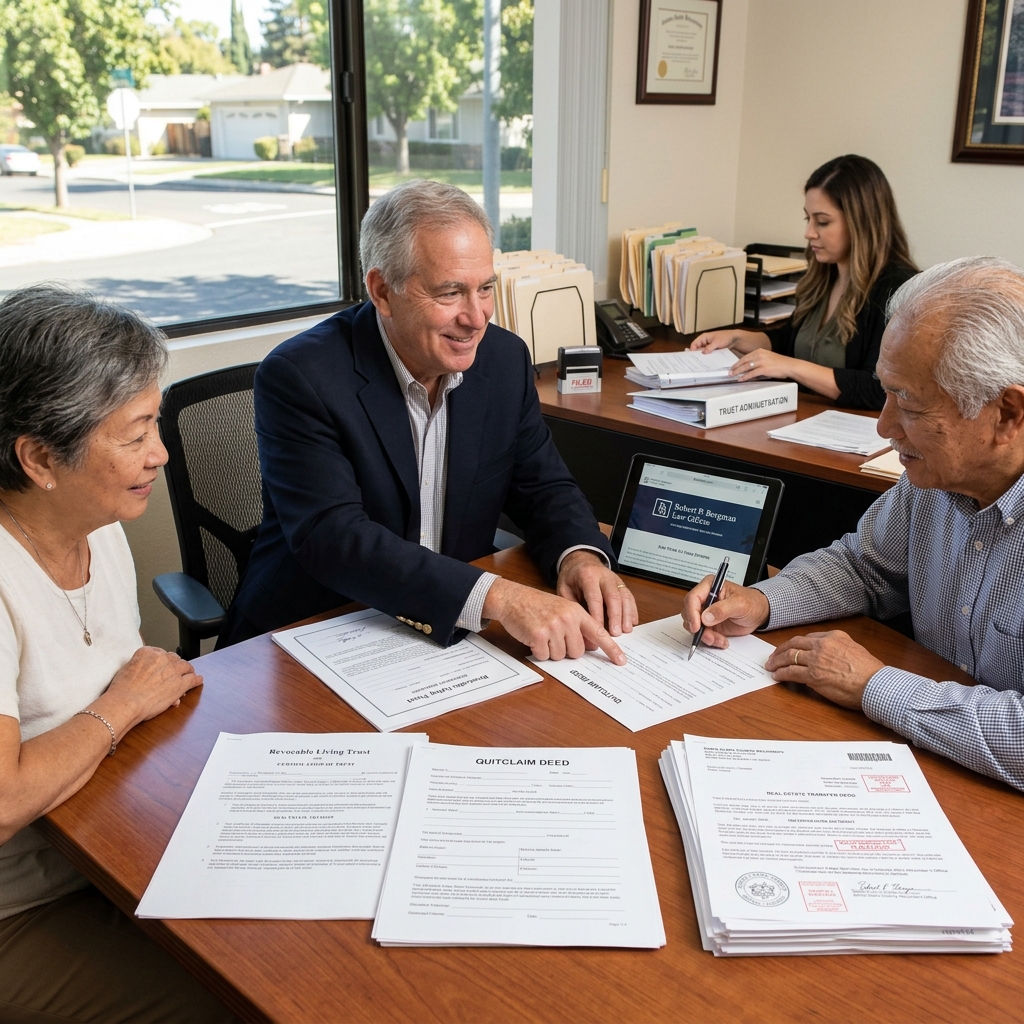
We handle real estate trust funding as a core service. Our process ensures every detail aligns with California law and your family’s long-term goals.
Here’s what we do:
We start by reviewing your current deed and your trust document together, identifying any gaps or mismatches. We confirm your property description matches county records exactly. We then prepare a new deed using the precise language California requires for trust transfers, including all necessary trust references and successor trustee designations.

Next, we coordinate with your title company to ensure the new deed will record cleanly without title issues. We guide you through signing before a notary (required for deeds in California). Finally, we file the recorded deed in your county records and obtain a certified copy for your records.
Throughout this process, we flag any complications: mortgages that might require lender approval, properties in multiple counties, business real estate with special considerations, or existing Proposition 13 concerns.
The outcome: your property is legally titled in your trust, your family avoids probate, and your documents are clear enough to survive any future challenge. You gain legitimate peace of mind, not false confidence.
Comparing Timeline and Efficiency: Speed to Protection
DIY trust funding typically takes 4-8 weeks if everything goes smoothly. That timeline assumes you correctly identify what needs doing, find templates that match California requirements, coordinate notarization, and handle county recording yourself. Most people underestimate complexity and experience delays.
Our process typically completes within 2-3 weeks. We’ve already prepared hundreds of these transfers, know exactly what Santa Clara County requires, maintain relationships with title companies, and handle all coordination internally. You provide basic information, we handle execution.
More importantly, we do it correctly the first time. We’ve seen people take months untangling DIY transfers that created title problems or trust language mismatches. That “saved time” becomes thousands in professional cleanup later.
Start your process now rather than leaving it to chance. The sooner your property sits safely in your trust, the sooner your family has real protection.
Comparing Legal Compliance: State Requirements and Documentation
California’s trust funding requirements are strict but clear. Your deed must include your trust’s exact legal name, the date it was executed, and the trustee’s current name and authority.
The deed itself must be properly formatted according to California statutory requirements. It needs an accurate legal description of the property (which requires checking your current deed and property records against county assessor data). If you’re transferring a mortgaged property, you may need to confirm your lender permits the transfer or provide Notice of Completion documentation.
We verify:
- Trust authority and successor trustee language matches current California law
- Deed format complies with California Civil Code requirements
- Property description is legally accurate and matches county records exactly
- Notarization is properly executed
- All required disclosures are included
One missed requirement forces you back to the county recorder. Multiple rejections mean re-notarization, re-recording fees, and weeks of frustration. Our experience means we file it right the first time.
Comparing Long-Term Asset Protection: Peace of Mind vs Risk
DIY trust funding creates ongoing risk. If a title issue emerges years later during sale or refinance, you’re explaining to a title company why your transfer documentation is incomplete or improper. Title insurance may not cover the defect. Your family inherits the problem.
Professional trust funding documentation holds up under scrutiny. If anyone later questions whether your property was properly transferred into your trust, the clear, correctly prepared deed and recorded documents prove it conclusively. This protection extends decades into the future, potentially shielding your heirs from disputes or tax complications.
Consider a specific scenario: your daughter inherits the property after your death. She wants to sell it. The title company discovers the original trust transfer deed had missing language. Now she’s delayed, paying attorneys to clarify ownership, possibly filing a Heggstad petition to get court validation. A properly funded trust eliminates this entire risk category.
Why Professional Guidance Prevents Costly Errors
We’ve spent decades specializing in trust funding specifically because it’s where small errors create disproportionately large consequences. A will mistake might only surface after death. A trust funding mistake surfaces at the worst possible moment: when your heirs are grieving and trying to settle your estate.
Common errors we prevent:
- Funding only part of your property (leaving some assets outside the trust)
- Using a spouse’s name incorrectly on joint property
- Transferring property with outstanding tax liens or judgment issues
- Missing the successor trustee’s authority to act after your death
- Creating unintended income tax consequences
Each of these requires professional remediation, costing thousands to correct. We identify and fix these issues during the funding process, not years later.
How We Handle Complex Property Situations
Not every property transfer is straightforward. We’ve handled:
Multiple properties. Coordinating trusts across several counties requires understanding each county’s recording requirements and ensuring consistent naming across all deeds.
Investment properties with mortgages. We navigate lender requirements, ensure the deed properly reflects debt obligations, and coordinate with your loan servicer to confirm the transfer doesn’t trigger a due-on-sale clause.
Properties held jointly. If you own with a spouse or others, we ensure the new deed language properly reflects all owners’ interests and trust designations.
Business real estate. Commercial properties sometimes have special lease or operating agreement implications. We coordinate with your business accountant and attorney.
Blended family situations. We structure transfers to protect your specific wishes, ensuring property flows to your chosen beneficiaries even in complex family circumstances.
These situations require experience, not just template completion.
The Hidden Costs of Getting It Wrong
If your trust funding fails, you’re looking at probate costs for that property. California probate costs typically run 3-7% of the property’s value in attorney fees and court costs alone. On a $1.2 million home, that’s $36,000-$84,000.
Beyond probate costs, there’s delay. Your heirs can’t access the property for months while probate processes. If the property generates income or requires maintenance, that becomes your estate’s problem, not your heirs’ opportunity.

There’s also the emotional cost of exposing your family finances publicly through the probate process. California probates involve public court documents listing all your assets.
A single missed element in DIY trust funding can trigger all these costs. We’re talking about a difference between spending $1,500-$2,500 on professional trust funding now versus $40,000-$80,000 in probate costs plus family stress later.
Our Comprehensive Trust Administration Support
Trust funding is just the beginning of your asset protection strategy. We don’t simply hand you documents and disappear.
After funding your trust, we help you manage its ongoing administration. Life changes: properties appreciate, mortgages get refinanced, your family circumstances shift. We review and update your trust documents as needed, ensure new properties get properly funded, and help your successor trustee understand their responsibilities before they’re needed.
When you pass away, our trust administration services guide your family through settling your estate efficiently, distributing assets correctly, and avoiding common administration mistakes. Your successor trustee isn’t navigating this alone.
This ongoing relationship means your entire estate plan stays current and protected throughout your life and beyond.
Why Working With Us Is Your Best Choice
We’re not a one-size-fits-all legal service. We specialize in estate planning and trust administration for Santa Clara County families specifically. We understand California’s unique probate rules, local county requirements, and how trusts interact with California property law.
More importantly, we measure our success by whether your family actually avoids probate and inherits smoothly. We’re not optimizing for fastest processing or lowest cost. We’re optimizing for correctness, clarity, and genuine asset protection.
We’ve handled hundreds of real estate trust fundings. We know exactly what works, what creates problems, and how to structure your transfer for maximum protection. When complications arise, we solve them inside our process rather than creating future problems you’ll inherit.
Your home deserves better than a template. Your family deserves better than guesswork. Work with us, and you get expertise, accountability, and genuine peace of mind.
Next Steps: Schedule Your Trust Funding Consultation
The first step is simple: schedule a consultation with us to review your current property situation and trust documents.
During this meeting, we’ll identify whether your properties are properly funded, flag any complications specific to your situation, and outline exactly what we’d do to protect your assets. You’ll understand your actual risk and the precise path forward.
We offer straightforward guidance without pressure. Many families find that a 30-minute conversation eliminates confusion and uncertainty they’ve carried for years.
Contact our office today to schedule your consultation. Let’s ensure your California real estate is properly protected and your family’s inheritance is secure. Your peace of mind is worth the conversation.
