
If you haven’t legally named a guardian, do you know which local judge will decide who raises your children? It’s a chilling thought that keeps many California parents awake at night. You likely already feel the weight of this responsibility, yet the complexity of state law often leads to “planning paralysis.” Taking the first step into estate planning for parents with minor children California doesn’t have to be overwhelming. It’s about replacing that underlying anxiety with a concrete, defensive strategy that protects your legacy and your kids.
We’ll help you secure your children’s future by mastering the legal framework for naming guardians and managing inheritances under the latest 2026 regulations. You’ll learn why the person who tucks your children into bed doesn’t necessarily have to be the one managing their bank accounts. This guide previews the essential roles of “Person” versus “Estate” guardians, the impact of the current $208,850 probate threshold, and how a properly structured trust prevents the court from making the most personal decisions of your life. By the end of this article, you’ll have a clear roadmap to ensure your family remains protected and your wishes remain final.
Key Takeaways
- Understand the “Best Interests of the Child” standard that California judges use and how you can influence their decision through formal legal documentation.
- Learn why separating the role of a daily caregiver from a financial manager often provides the most secure foundation for your child’s future.
- Discover how comprehensive estate planning for parents with minor children California utilizes Revocable Living Trusts to bypass the 12 to 18 month probate timeline.
- Identify the specific legal steps to name guardians for both long-term care and sudden incapacity to ensure your children are never left in the hands of the court.
- Explore how to integrate specialized tools like Special Needs Trusts to protect inheritances for children with disabilities without jeopardizing their public benefits.
Understanding Legal Guardianship for Minors in California
Under California Probate Code section 1500, a legal guardian is an adult appointed by the court to take over the parental responsibilities for a minor. While you might have a close friend or sibling in mind, the law doesn’t recognize a simple handshake or a verbal promise. Effective estate planning for parents with minor children California requires formalizing these choices in a written Will. Even then, the court retains final authority. Judges follow the “Best Interests of the Child” standard, which means they’ll look at the nominee’s health, stability, and relationship with your kids before confirming the appointment.
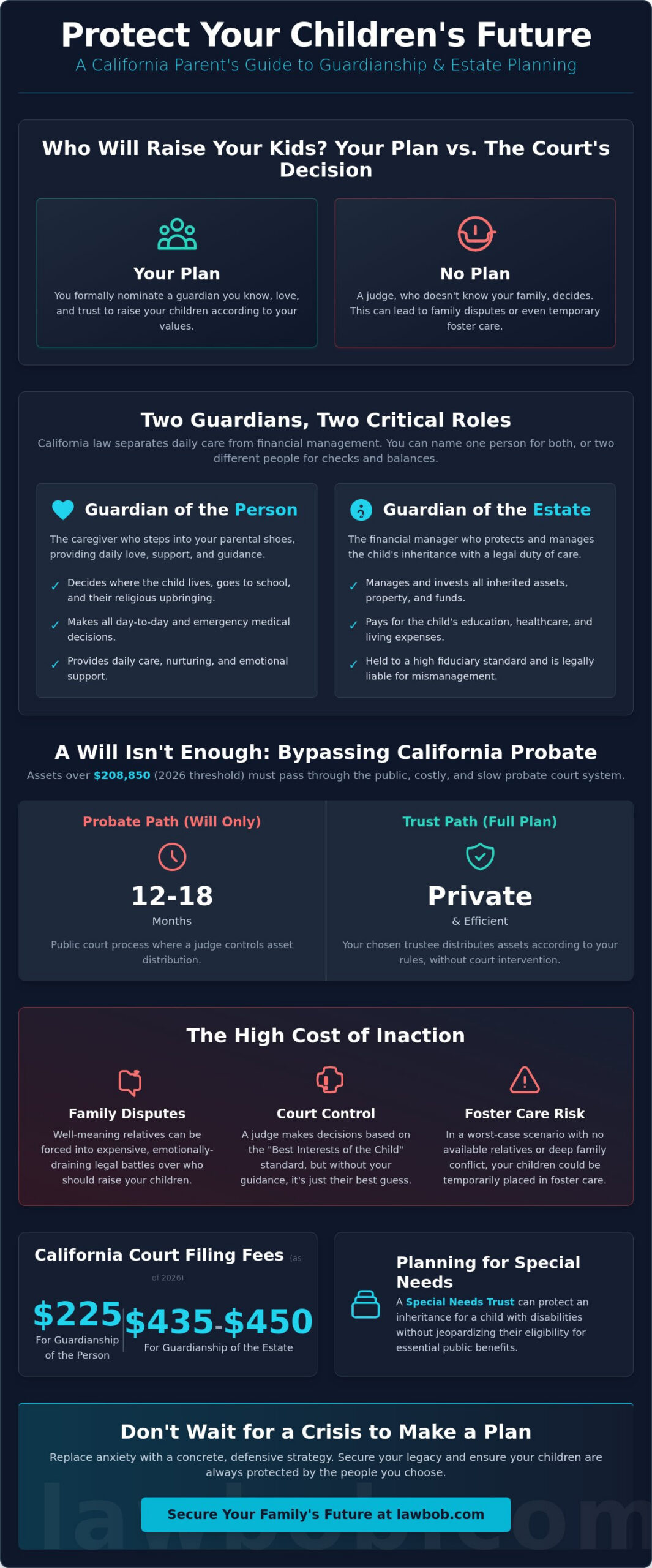
Think of your nomination as a directive to the judge. Without it, the court starts with a blank slate. They won’t know that you intentionally passed over a specific relative because of their lifestyle or that you wanted your children raised in a particular faith or community. Formalizing your legal guardianship preferences ensures your voice is heard in the courtroom when you aren’t there to speak. Be aware that the legal process involves specific costs. As of 2026, the court filing fee for a guardianship of the person is $225, while a guardianship of the estate or both roles typically costs between $435 and $450.
When Does a Guardian Step In?
A guardian’s role begins when both legal parents are deceased or deemed legally incapacitated. In the high-pressure environments of Silicon Valley, incapacity can stem from sudden medical crises or severe accidents that leave parents unable to make daily parenting decisions. You must distinguish between a temporary emergency guardian, who might step in for a few days, and a permanent guardian who will raise your children until they reach 18. Your estate plan should address both scenarios to prevent any gap in care or confusion during a crisis.
The Consequences of Failing to Nominate
If you haven’t named a guardian, the California court system is forced to choose one for you. This often triggers expensive and emotionally draining legal battles among well-meaning relatives who disagree on what’s best for the kids. In the worst-case scenario, if no relatives are immediately available or if the family is in deep conflict, your children could be placed in temporary foster care while the judge sorts through the chaos. Estate planning for parents with minor children California isn’t just about assets; it’s about keeping your children out of the system and in the arms of people you trust.
Guardianship of the Person vs. Guardianship of the Estate
When you start estate planning for parents with minor children California, you will quickly find that “guardian” is a broad term. In reality, California law splits this responsibility into two distinct legal roles. One person manages the child’s daily life; the other manages the child’s money. While many parents instinctively name the same person for both, this isn’t always the most strategic move for your family’s security. The person who provides the best emotional support might not have the financial discipline required to manage a complex inheritance or a Silicon Valley real estate portfolio.
If you don’t have a trust in place, California law views a minor’s inheritance with significant caution. Children under 18 cannot legally own or manage property of significant value. Without your specific instructions, the court must appoint a guardian of the estate to oversee every penny until the child reaches adulthood. This role carries a heavy fiduciary duty, meaning the person must act with the highest standard of care and loyalty. If they fail, they can be held personally liable for any financial losses. Understanding these distinctions is a core part of estate planning for parents with minor children California families can trust.
The Guardian of the Person
This individual steps into your shoes to provide for the child’s daily needs. Their authority is comprehensive and includes the power to decide where the child lives, what they eat, and what they wear. In California, this guardian has the legal right to choose the child’s school, extracurricular activities, and religious upbringing. They are also responsible for all medical decisions, from routine checkups to specialized therapy or emergency surgeries. Because this role is so personal, you should choose someone whose values and parenting style align closely with your own.
The Guardian of the Estate
The guardian of the estate focuses exclusively on the minor’s finances. This includes managing life insurance payouts, social security benefits, or any assets left behind in a Will. The court maintains a watchful eye over this role. The guardian must file regular, detailed accountings with the California Probate Court to prove that the money is being used solely for the child’s benefit. You can find more details on these strict reporting requirements in the official California probate guardianship documentation. Because of this administrative burden, many parents choose to create a Revocable Living Trust. A trust allows a Trustee to manage assets privately, avoiding the restrictive oversight and public filings required of an estate guardian.
How to Choose the Right Guardian: A Strategic Framework
Selecting a guardian is often the most emotional hurdle in estate planning for parents with minor children California. It’s a decision that requires you to look past family obligations and focus on the practical reality of your children’s future. You aren’t just choosing someone who loves your kids; you’re choosing a person who can manage the logistics of a household while providing emotional stability. Guardian Suitability is a balance of emotional capacity and logistical readiness. By applying a strategic framework, you can move past the “what-if” anxiety and make a choice rooted in logic and love.
Consider the “Age and Stage” factor when evaluating candidates. While grandparents often have the most time and the strongest desire to help, you must honestly assess their long-term health and physical ability to keep up with young children over a decade or more. Conversely, a younger sibling or friend might have the energy but lack the financial stability or a stable home environment. This is why estate planning for parents with minor children California often includes naming a primary guardian and at least one alternate. It creates a safety net that accounts for the fact that life circumstances for your nominees will inevitably change over time.
Values, Religion, and Education
Living in the San Jose area often means prioritizing a high-performance educational environment. You should ask whether a potential guardian is prepared for the competitive nature of Silicon Valley schools or if they have a fundamentally different view on academic pressure. Discuss your disciplinary styles and religious preferences openly. Don’t assume your sister or best friend shares your philosophy just because you get along at holiday dinners. Conduct a formal interview before you finalize your documents. This transparency reduces the risk of future family conflict and ensures your nominee is actually willing to accept the immense responsibility of the role.
Logistics and Geography
Geography plays a massive role in a child’s stability. If your children are currently thriving in San Jose schools, moving them to a different state could add a layer of trauma to an already difficult transition. California judges often prefer nominees who can maintain the child’s existing community ties. Consider the nominee’s current housing situation. Do they have enough space for your children, or would they need to move to a larger home? If you nominate an out-of-state guardian, you must document your reasoning clearly. This helps the court understand why moving away from California is truly in the child’s best interest despite the loss of local school and social connections.
The Legal Process: Formalizing Your Nomination in California
Once you have selected the right people to care for your children, you must translate those intentions into legally enforceable documents. In California, a simple letter or a digital note isn’t enough to bypass the court’s default procedures. Comprehensive estate planning for parents with minor children California involves a multi-step process to ensure your nominations are recognized during both death and incapacity. By following these steps, you provide the court with a clear mandate that protects your children from being caught in a legal vacuum.
Your first priority is drafting a valid California Last Will and Testament. This document serves as the primary vehicle for naming a guardian to take over after your death. However, a Will only becomes effective after you pass away. To protect your children during a medical crisis or prolonged incapacity, you should also create a stand-alone Nomination of Guardian. This document allows your chosen individual to step in immediately if you’re unable to care for your kids due to an accident or health emergency. Always appoint successor guardians in these documents. If your first choice is unavailable or unwilling to serve when the time comes, having a Plan B and Plan C prevents the court from having to choose a relative you might not trust.
Execution is the final hurdle. In California, a Will must be signed in the presence of two disinterested witnesses who also sign the document. While a Nomination of Guardian doesn’t strictly require a notary, having it notarized adds a layer of authenticity that judges appreciate. Once signed, keep these documents in a secure, fireproof location and notify your nominees of their potential roles. They should know where the documents are kept so they can present them to the court without delay.
Wills vs. Stand-Alone Nominations
It’s a common misconception that a Will covers every scenario. Because a Will only speaks at death, it leaves a dangerous gap during periods of parental incapacity. A stand-alone Nomination of Guardian fills this void. When presented to the Santa Clara County Probate Court, these documents act as your legal voice. They provide the judge with the necessary evidence to honor your wishes rather than relying on the testimony of competing family members. If you’re ready to formalize these protections, you can start your estate planning process today to ensure no gaps exist in your children’s safety net.
Working with the Santa Clara County Courts
If you live in San Jose or surrounding areas, your guardianship case will likely be handled by the Santa Clara County Superior Court. Unlike a simple administrative filing, the court will launch an investigation into your nominated guardian. A court-appointed investigator will interview the nominee, check their background, and potentially visit their home to ensure it’s a safe environment for your children. In local Silicon Valley courts, this confirmation process can take several months. Providing the court with a clear, professionally drafted nomination helps streamline this investigation and reduces the emotional strain on your children during the transition.
Integrating Guardianship into a Silicon Valley Estate Plan
Securing your children’s well-being is a two-part mission. While your Will names the people who will provide daily care, your Revocable Living Trust manages the resources they need to do the job. In the context of estate planning for parents with minor children California, a trust is the most effective tool to ensure that a large inheritance doesn’t become a burden. By separating the roles of Guardian and Trustee, you create a built-in system of checks and balances. The Guardian focuses on the child’s emotional and physical needs, while the Trustee manages the assets, ensuring funds are spent wisely and according to your specific instructions.
For families with children who have disabilities, a standard trust isn’t enough. You must incorporate Special Needs Trusts to protect your child’s eligibility for essential public benefits. Without this specific legal structure, a direct inheritance could disqualify them from receiving government assistance. Additionally, Silicon Valley professionals should review their guardian nominations every three to five years. Careers in tech often lead to frequent relocations, and the person you chose five years ago might now live across the country or have a vastly different family dynamic that no longer fits your parenting vision.
The Role of the Revocable Living Trust
A properly funded trust allows your family to avoid a restrictive and public Guardianship of the Estate. Instead of a court-appointed individual filing intrusive financial reports, your Trustee manages the inheritance privately. You can specify that funds be used for the child’s “HEMS”-an industry term for Health, Education, Maintenance, and Support. This ensures the money covers everything from San Jose private school tuition to medical emergencies. Unlike California Uniform Transfers to Minors Act (CUTMA) accounts, which usually hand over full control at age 18 or 21, a trust lets you stagger distributions. You might choose to release portions of the principal at ages 25, 30, and 35, providing your children with a financial safety net as they mature.
Partnering with a San Jose Estate Planning Expert
Choosing guardians and trustees are some of the most sensitive decisions you’ll ever make. You don’t have to navigate these choices alone. Working with a State Bar of California Certified Specialist like Robert P. Bergman provides you with the precision and mentorship needed to avoid common pitfalls. Our firm focuses on creating defensive, highly organized plans that align with the unique needs of Silicon Valley families. We help you evaluate your nominees through a practical lens, ensuring your legacy is protected by reliable legal structures. To get started, schedule a consultation with the Law Offices of Robert P. Bergman to secure your children’s future and gain the peace of mind that comes from being truly prepared.
Take Control of Your Family’s Safety Today
You now have the framework to distinguish between the daily care provided by a guardian and the financial oversight managed by a trustee. By formalizing these roles through a valid Will and a Revocable Living Trust, you ensure that the Santa Clara County Probate Court follows your specific instructions rather than a default legal formula. Effective estate planning for parents with minor children California is about more than just moving assets; it’s about providing a stable, predictable future for those you love most.
Robert P. Bergman has served the San Jose, Sunnyvale, and Silicon Valley community since 1980 as a State Bar of California Certified Specialist in Estate Planning, Trust, and Probate Law. Our firm specializes in non-litigated, family-centric estate solutions designed to reduce anxiety and maximize security. Secure your children’s future with a comprehensive California Estate Plan and move forward with the confidence that your plan is built to last. You’ve taken the first step by getting informed; now, let’s turn that knowledge into a defensive shield for your family.
Frequently Asked Questions
Can I name two people to serve as co-guardians in California?
Yes, you can name co-guardians, though it requires careful consideration of how they’ll work together. Most parents choose a married couple to provide a stable, unified household for their children. If you select two individuals who don’t live together, you might create logistical challenges for the court regarding daily care and decision making. It’s often cleaner to name one primary guardian and a successor to avoid potential conflicts.
What happens if the person I named as guardian refuses to serve?
If your primary choice is unable or unwilling to serve, the court will look to the successor guardians you’ve listed in your legal documents. This is why naming at least two back-up choices is a vital part of estate planning for parents with minor children California. If you haven’t named any successors and your first choice refuses, a judge must decide who is best fit among any relatives or friends who petition the court.
Does a guardian for my child have to live in California?
Your chosen guardian doesn’t have to be a California resident to be appointed by the court. While state law allows out-of-state guardians, a judge will closely evaluate whether moving your children away from their current school and community is truly in their best interest. If your top choice lives elsewhere, you should document your specific reasons for that choice to help the court understand your parenting philosophy.
How is a guardian of the estate different from a Trustee?
A guardian of the estate is a court-appointed role that involves strict judicial oversight and typically ends when the child turns 18. A Trustee, however, manages assets privately according to the specific rules you’ve written into your Revocable Living Trust. Using a Trustee is generally preferred because it keeps your family’s financial business out of public court records and allows for asset management to continue into the child’s adult years.
Can I prevent a specific relative from ever becoming my child’s guardian?
You can include specific exclusionary language in your Will to state that a certain person should never serve as a guardian. While you don’t need to be defamatory, providing the court with factual reasons for the exclusion helps a judge understand why that individual doesn’t meet the necessary safety standards. This proactive step prevents the court from making an appointment that goes against your core values or parenting style.
How often should I update my guardian nominations in San Jose?
Review your nominations every three to five years to ensure your choices still reflect your current reality. In a high-mobility area like San Jose, your nominees may relocate, experience health changes, or go through life shifts like divorce that impact their ability to care for your kids. Keeping your estate planning for parents with minor children California updated ensures that your legal documents always match your family’s current needs.
Do I need a separate guardian if I already have a Living Trust?
Yes, you still need to name a guardian even if you’ve already established a Revocable Living Trust. A trust is an excellent tool for managing your money and real estate, but it lacks the legal authority to appoint a person to take physical custody of your children. You must use a Will or a stand-alone Nomination of Guardian to legally designate who will handle the daily upbringing of your minors.
What is the Best Interests of the Child standard in California courts?
The “Best Interests of the Child” is the foundational legal standard California judges use to decide who should raise a minor. The court examines the child’s health, safety, and welfare, as well as the emotional ties between the child and the proposed guardian. Judges also look for a home environment that provides stability and continuity, ensuring the child can thrive despite the loss of their parents.

Article by
Robert P. Bergman
Bob Bergman has been a Board Certified Specialist in Estate Planning, Trust and Probate Law since 2011, as certified by the California State Bar Board of Legal Specialization. For over 40 years, Bob has assisted families in Santa Clara County and the greater San Francisco Bay Area with estate planning, trust administration, and specialty court petitions involving trusts. Bob is friendly, very approachable, and believes in explaining complex legal topics in clear ordinary language so that his clients understand exactly what they're doing and why they're doing it.
Disclaimer
This article is for informational purposes only. Nothing in this article is intended to replace legal advice from a competent attorney. Nobody should rely on information in this article in making legal decisions without such consultation.