
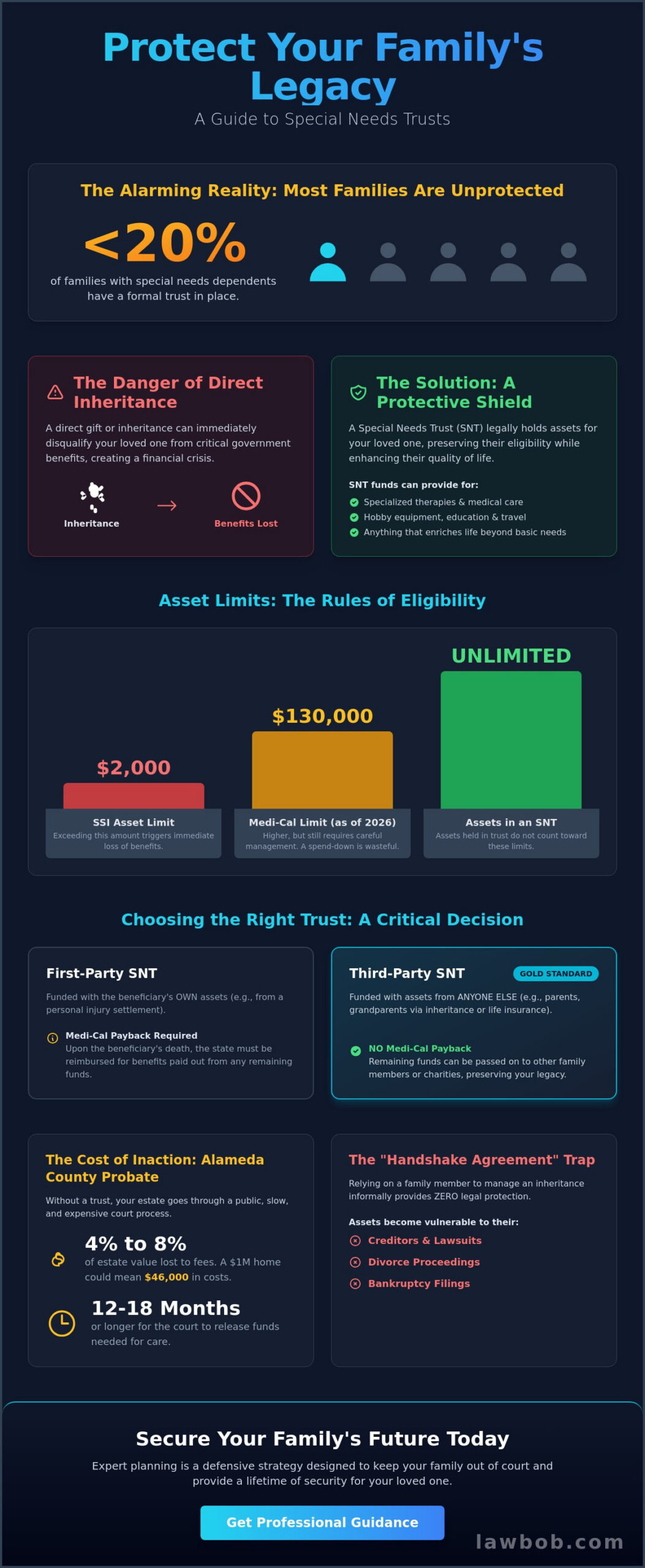
Did you know that fewer than 20% of families with special needs dependents have actually established a formal special needs trust? It’s a startling figure, but it’s understandable when you consider how overwhelming the legal landscape can feel. Many parents in Alameda County live with the constant anxiety that a well intentioned inheritance might lead the state to seize assets or disqualify their child from essential care. You aren’t alone if you’ve felt confused by the complex Medi-Cal rules or worried about who will manage the money when you no longer can.
The good news is that special needs trust planning in Union City provides a clear, defensive strategy to protect your family’s legacy. By reading this guide, you’ll learn how to secure your loved one’s financial future while maintaining their eligibility for SSI and Medi-Cal benefits. We’ll walk you through the updated 2026 asset limits, show you how to avoid the 4% to 8% cost of California probate, and provide a roadmap for choosing a reliable trustee who understands your family’s unique needs.
Key Takeaways
- Learn how a properly structured trust prevents a direct inheritance from triggering an immediate loss of SSI or Medi-Cal benefits for your loved one.
- Discover the critical differences between First-Party and Third-Party trusts to determine the most effective financial safety net for your family’s situation.
- Understand why informal “handshake” agreements with siblings often fail and how to protect inherited assets from future creditors, divorce, or bankruptcy.
- Expert special needs trust planning in Union City can help you bypass the complex Alameda County probate system and utilize Heggstad Petitions to secure unfunded assets.
- See how working with a Certified Specialist ensures your legal documents are designed as defensive strategies to keep your family out of court and maintain long-term security.
Protecting Benefits: Why Special Needs Trust Planning is Essential in Union City
A Special Needs Trust (SNT) is a specific legal structure designed to hold assets for a person with a disability without those assets counting against their eligibility for government assistance. It acts as a protective shield. By using special needs trust planning in Union City, you ensure that your loved one can enjoy a higher quality of life while keeping their essential safety net intact. This legal tool allows you to set aside funds that a trustee manages for the beneficiary’s benefit, providing a level of security that a simple will cannot offer.
The danger of a direct inheritance is very real. If a well meaning relative leaves even $2,000 directly to a person receiving Supplemental Security Income (SSI), that individual will likely lose their benefits immediately. This isn’t just a minor administrative hurdle. It’s a financial crisis that can halt access to medical care and housing support. For many families, the fear isn’t just about the money; it’s about the loss of the stable, state funded support systems that their loved one relies on every day.
In the San Francisco Bay Area, government benefits rarely cover the true cost of a comfortable life. Union City families know that basic care isn’t enough. An SNT fills this gap by providing for supplemental needs. These funds can pay for specialized therapies, hobby equipment, or even travel that SSI payments won’t cover. It transforms a life of mere subsistence into one of enrichment and dignity.
Understanding the SSI and Medi-Cal Asset Limits in 2026
As of January 1, 2026, California has reinstated asset limits for most Medi-Cal programs. For an individual, that limit is now $130,000. While this is higher than the strict $2,000 limit for SSI, it still requires careful management. You might hear people suggest a spend down strategy, which involves quickly spending an inheritance to qualify for benefits. This is often a mistake. It wastes resources that could’ve provided decades of support if placed within a trust. Professional special needs trust planning in Union City avoids this waste, preserving the principal for the long term.
The Cost of Inaction: Alameda County Probate Realities
If you don’t have a plan, the Alameda County Superior Court will step in. Probate is a public, slow, and expensive process. In California, statutory attorney fees are set by law based on the gross value of the estate. For a $1 million home in Union City, the combined fees for the attorney and executor can reach $46,000. These funds are taken directly from the inheritance. Beyond the money, the delay factor is grueling. A person requiring constant care shouldn’t have to wait 12 to 18 months for a court to release the funds they need to survive.
Choosing Between First-Party and Third-Party Special Needs Trusts
Deciding which legal vehicle fits your family is the most critical step in the process. Not all trusts are created equal, and the “best” option depends entirely on whose money is being used to fund the account. When you begin special needs trust planning in Union City, you’ll quickly find that the distinction between First-Party and Third-Party trusts determines whether the state of California can claim a portion of the assets later. Choosing the wrong structure can lead to unnecessary taxes or the loss of a hard earned family legacy.
Third-Party Trusts: The Ultimate Gift for Heirs
A Third-Party Special Needs Trust is often considered the gold standard for parents and grandparents. It’s funded with “other people’s money,” such as an inheritance, life insurance proceeds, or real estate. Because the disabled beneficiary never technically owned these assets, these trusts don’t require a Medi-Cal payback provision. This means that when the primary beneficiary passes away, any remaining funds can be distributed to other family members, such as siblings or grandchildren.
For Union City families, these trusts also offer significant tax advantages. They can be established as part of a larger estate plan to ensure that assets are managed professionally rather than being handed over in a lump sum. If you’re concerned about how specific assets like a family home might impact eligibility, reviewing the details of Special Needs Trusts can help clarify your options.
First-Party Trusts and the Payback Provision
A First-Party trust is necessary when the person with a disability receives money directly. This often happens due to a personal injury settlement, a direct inheritance from a relative who didn’t plan ahead, or an unexpected windfall. Under California’s Special Needs Trust rules, these trusts must include a “Medi-Cal Payback” provision. This requires the trustee to reimburse the state for any medical expenses paid on behalf of the beneficiary after they pass away.
The Social Security Administration enforces a strict “sole benefit” rule for these accounts. Every dollar spent must be for the direct benefit of the disabled individual. While these trusts are more restrictive, they’re essential for protecting a beneficiary who suddenly finds themselves with assets over the 2026 individual limit of $130,000 for Medi-Cal or the $2,000 limit for SSI. If the assets are too small to justify a standalone trust, some families look into Pooled Trusts, where a non-profit organization manages the funds alongside assets from other families to reduce administrative costs. Effective special needs trust planning in Union City ensures that regardless of the funding source, your loved one’s care remains the top priority.
The ‘Moral Obligation’ Trap: Why Informal Inheritance Plans Fail
Many parents feel that the simplest way to provide for a disabled child is to leave the entire inheritance to a “reliable” sibling. They operate on the assumption that family loyalty and a shared history will ensure the money is used as intended. However, this is a dangerous financial gamble. Without formal special needs trust planning in Union City, you’re relying on a “moral obligation” that carries no weight in a courtroom. This approach often leads to unintended consequences that can leave a vulnerable loved one with no support at all.
When you leave money directly to a sibling, that inheritance legally becomes their personal property. If that sibling faces a divorce, a lawsuit from a car accident, or a business bankruptcy, the funds meant for your disabled child are considered a seizable asset. Creditors don’t care about your private family “understanding.” If the money isn’t held within a legally recognized trust, it’s vulnerable to every complication in the sibling’s life. A Special Needs Trust is the only way to ring-fence these assets, ensuring they remain dedicated to the person you intended to protect.
There’s also the risk of “accidental disinheritance.” If the sibling passes away before the disabled heir, the money typically follows the sibling’s own estate plan, often going to their spouse or children. The disabled relative is left out in the cold. Formal planning prevents this by clearly defining where the money goes at every stage of the process.
Legal vs. Moral Responsibility
A moral obligation is not a legal one. In the eyes of the law, a sibling has no requirement to spend their inheritance on someone else. Commingling these funds with personal bank accounts makes them impossible to track and can trigger a total loss of public benefits for the special needs heir. By establishing a trust, you remove this immense financial burden from the sibling’s shoulders. This often helps preserve the family relationship by preventing future resentment or confusion over money.
Selecting the Right Trustee in Union City
Choosing who will manage the money is a high-stakes decision for Alameda County residents. While a family member knows the beneficiary’s daily needs, they may struggle with complex tax filings or government reporting requirements. Professional trustees in the Silicon Valley area offer objectivity and expertise that can prevent costly mismanagement. You might also consider a “Trust Protector,” an independent party who can remove or replace a trustee if they aren’t acting in the beneficiary’s best interest. If you fail to name a successor and the matter ends up in the Alameda County Probate Court, a judge will decide who manages your family’s legacy. Proactive special needs trust planning in Union City keeps that power in your hands.
Navigating Alameda County Probate and Medi-Cal Rules in 2026
Stay ahead of the shifting regulatory environment by understanding how local court procedures impact your family’s security. Effective special needs trust planning in Union City requires more than just standard documents; it demands a technical understanding of the Alameda County Superior Court’s specific preferences. As of January 1, 2026, California has fully reinstated asset limits for Medi-Cal programs at $130,000 for individuals. While this is more generous than the limits of the past, the state has also implemented a 30-month look-back period for nursing facility care. This means that last minute asset transfers are no longer a viable strategy for many families.
The Heggstad Petition Advantage
A common mistake occurs when a family creates a trust but forgets to transfer their Union City home into it. Normally, this oversight would force the estate into a full probate proceeding, which can cost tens of thousands of dollars in statutory fees and take over a year to resolve. However, the Law Offices of Robert P. Bergman utilizes a specific legal tool called a Heggstad Petition. This allows us to ask the court to declare that the property is part of the trust, even if the deed was never formally updated. It’s a faster, significantly less expensive alternative to probate that keeps your private family matters out of the public record.
ABLE Accounts and SNTs: A Powerful Duo
One of the most significant changes in 2026 is the expansion of the ABLE Age Adjustment Act. The age by which a disability must have begun for an individual to be eligible for a CalABLE account has been raised from 26 to 46. This opens the door for thousands of additional residents to use ABLE accounts alongside their Special Needs Trusts. While an SNT is perfect for holding large assets like real estate or life insurance, an ABLE account is superior for daily expenses. You can use ABLE funds to pay for housing and food without the Social Security Administration reducing the beneficiary’s SSI payment, which is a common pitfall with standard trusts.
Precision in drafting is essential to comply with the latest POMS updates from the Social Security Administration. If your trust isn’t worded exactly right, it could be rejected during a benefits review, leaving your loved one without support. To ensure your plan meets every current California requirement, consider a professional review of your Special Needs Trust documents. Integrating these tools provides a level of flexibility and safety that a single document simply cannot achieve.
Designing Your Legacy: The Law Offices of Robert P. Bergman Approach
Choosing the right legal partner is about more than just filling out forms. When it comes to special needs trust planning in Union City, you need the expertise of a Certified Specialist in Estate Planning, Trust, and Probate Law. This certification represents a higher level of rigorous testing and verified experience that general practitioners often lack. Our firm focuses exclusively on non-litigated matters. We don’t spend our time in courtrooms fighting over contested estates; instead, we devote our energy to building “bulletproof” trusts designed to keep your family out of the Alameda County probate system entirely.
The consultative process at our firm is designed to replace your anxiety with a structured, predictable plan. We understand that the thought of your loved one losing their financial safety net is overwhelming. By focusing on how specific legal structures align with your individual family circumstances, we help you transition from uncertainty to self-assurance. We serve families throughout the region from our San Jose office, providing the local expertise necessary to navigate California’s unique regulatory environment in 2026.
A Mentor-Led Planning Process
Robert P. Bergman brings over 40 years of experience to every consultation. Having navigated decades of changing California laws, he acts as a mentor who has seen nearly every possible scenario. Our approach is grounded in accessibility. We avoid the cold, detached jargon often found in traditional legal institutions. Instead, we provide plain-language explanations for complex concepts like the 30-month look-back period or the “sole benefit” rule. This transparency ensures that you feel informed and empowered throughout the process. The result is a tailored, comprehensive estate plan that provides genuine peace of mind.
Next Steps for Union City Families
Preparing for your future doesn’t have to be a stressful experience. Before your initial consultation, it’s helpful to gather information regarding your current assets, life insurance policies, and the specific government benefits your loved one receives. This data allows us to create a precise roadmap for your future trustee. One of the unique markers of our firm is our commitment to a transparent, fixed-cost service model. You’ll never have to worry about unpredictable hourly billing or hidden fees. We believe that financial predictability is a cornerstone of a client-first philosophy.
When you’re ready to move from concern to action, we’re here to guide you. Take the first step toward securing your family’s legacy today. Schedule your consultation with the Law Offices of Robert P. Bergman to begin building a secure financial safety net for your loved one.
Building a Resilient Future for Your Family
Securing your loved one’s financial well-being requires moving beyond informal “moral obligations” and embracing legally sound structures. By choosing professional special needs trust planning in Union City, you protect essential SSI and Medi-Cal benefits from being lost to a direct inheritance. You’ve learned how the right trust structure, paired with a CalABLE account, creates a flexible safety net that covers what government programs won’t. Avoiding the delays and high costs of the Alameda County probate court is entirely possible with proactive, expert drafting.
Robert P. Bergman is a State Bar of California Certified Specialist with over 40 years of legal experience. Our firm maintains a specialized focus on non-litigated estate matters, ensuring your documents are built to withstand scrutiny and keep your family out of court. Don’t leave your family’s legacy to chance or complex state formulas. Take the next step toward certain, lasting security today.
Secure Your Family’s Future with a Certified Specialist
You have the power to create a roadmap that provides dignity and care for your loved one for decades to come. We’re here to help you turn that vision into a reality.
Frequently Asked Questions
What is the difference between a first-party and third-party special needs trust?
The primary difference lies in whose money is used to fund the trust. A first-party trust is funded with assets that already belong to the disabled individual, such as a personal injury settlement or a direct inheritance. A third-party trust is funded by someone else, usually a parent or grandparent. This distinction is critical because first-party trusts must include a provision to pay back Medi-Cal upon the beneficiary’s death, while third-party trusts do not.
Can a person with a special needs trust still live in Union City section 8 housing?
Yes, a beneficiary can live in Section 8 housing while receiving support from a trust. The key is how the trustee distributes the funds. HUD rules generally don’t count trust distributions as income if they are paid directly to third parties for non-housing expenses. However, if the trust pays for rent or utilities, it could potentially reduce the value of the housing voucher or impact SSI payments.
Does a special needs trust protect against Medi-Cal estate recovery in California?
Third-party trusts are generally exempt from Medi-Cal estate recovery because the assets never legally belonged to the beneficiary. This is a major benefit of special needs trust planning in Union City for parents who want to leave a legacy for other children after the disabled heir passes away. First-party trusts, however, are specifically designed to reimburse the state for medical costs before any remaining funds can go to heirs.
How much money can you put in a special needs trust in 2026?
There is no legal limit on the amount of money you can place into a special needs trust. Whether the trust holds $10,000 or $10 million, the assets remain “non-countable” for government benefit eligibility. This is essential in 2026, as California has reinstated asset limits for many Medi-Cal programs at $130,000 for individuals, making the trust a vital tool for holding assets that exceed that threshold.
Who should I choose as a trustee for my child’s special needs trust?
You should choose someone who is both financially organized and empathetic to the beneficiary’s specific needs. Many families in Alameda County opt for a professional fiduciary or a trust company to handle the complex tax and reporting requirements. You can still involve family members by naming them as “trust protectors” or co-trustees who focus on the personal care and lifestyle decisions of the beneficiary.
Can I use a special needs trust to buy a house in Union City for my heir?
Yes, a special needs trust can own real estate for the beneficiary’s use. The trust pays for the home, and the home is not counted as a resource for SSI or Medi-Cal purposes. This is a common strategy in special needs trust planning in Union City to ensure a loved one has stable, permanent housing in the high cost San Francisco Bay Area without jeopardizing their monthly support checks.
What happens to the money in a special needs trust when the beneficiary dies?
The outcome depends on the type of trust you established. If it’s a first-party trust, the law requires the trustee to first reimburse the state for any Medi-Cal expenses paid during the beneficiary’s life. If it’s a third-party trust, there is no state reimbursement required. In that case, the remaining assets are distributed exactly as you specified in the trust document, often going to siblings or other relatives.
How does an ABLE account work with a special needs trust in California?
ABLE accounts and special needs trusts are complementary tools that provide maximum financial flexibility. While trusts are better for holding large assets like a home, ABLE accounts are ideal for daily spending. As of January 1, 2026, the ABLE Age Adjustment Act allows anyone who became disabled before age 46 to open an account. You can move money from the trust into the ABLE account to pay for housing and food without triggering the SSI “In-kind Support and Maintenance” reduction.

Article by
Robert P. Bergman
Bob Bergman has been a Board Certified Specialist in Estate Planning, Trust and Probate Law since 2011, as certified by the California State Bar Board of Legal Specialization. For over 40 years, Bob has assisted families in Santa Clara County and the greater San Francisco Bay Area with estate planning, trust administration, and specialty court petitions involving trusts. Bob is friendly, very approachable, and believes in explaining complex legal topics in clear ordinary language so that his clients understand exactly what they're doing and why they're doing it.
Disclaimer
This article is for informational purposes only. Nothing in this article is intended to replace legal advice from a competent attorney. Nobody should rely on information in this article in making legal decisions without such consultation.