
Did you know that your spouse might be legally barred from managing your Silicon Valley stock portfolio or making medical decisions for you if you suddenly become unable to speak for yourself? Most people believe a Will is enough, but a Will only takes effect after you’re gone. If you’re alive but incapacitated, you could find yourself trapped in a “living probate” where a judge, not your family, decides who manages your affairs. It’s a stressful reality for many, which is why planning for incapacity in Santa Clara is the most critical step you can take to protect your autonomy today.
We understand the anxiety that comes with thinking about medical emergencies and the high cost of legal proceedings in our county. You’ve worked hard for your legacy, and you deserve to know that your trusted family members can act immediately without a court’s permission. This article will show you how to secure your financial and medical future without the delay of court-ordered conservatorships. We’ll provide a clear roadmap to avoiding probate court while you’re alive, ensuring your high-value real estate and stock options remain protected by those you trust most.
Key Takeaways
- Define the critical difference between traditional estate planning and creating a roadmap for your medical and financial autonomy during your lifetime.
- Explore how a Revocable Living Trust and Durable Power of Attorney for Property work together to keep your private affairs out of the public court system.
- Learn how planning for incapacity in Santa Clara provides specific protections for Silicon Valley assets, including RSUs, ISOs, and high-value real estate.
- Identify why common strategies like joint tenancy often fail to provide the immediate legal authority a spouse needs during a medical emergency.
- Understand the risks of using DIY legal forms and why specialized legal drafting is necessary to meet the strict requirements of California financial institutions.
What is Incapacity Planning in Santa Clara County?
Incapacity is defined as the inability to manage financial affairs or personal care due to injury or illness. While many people believe their estate plan is complete once they sign a Will, that document is actually silent while you are alive. A Will only speaks after death. In contrast, planning for incapacity in Santa Clara creates a set of legal instructions that trigger only when you cannot speak or act for yourself. It is a proactive strategy designed to protect your autonomy during your lifetime. It ensures that your medical care and financial assets remain under the control of people you trust rather than a court-appointed stranger.
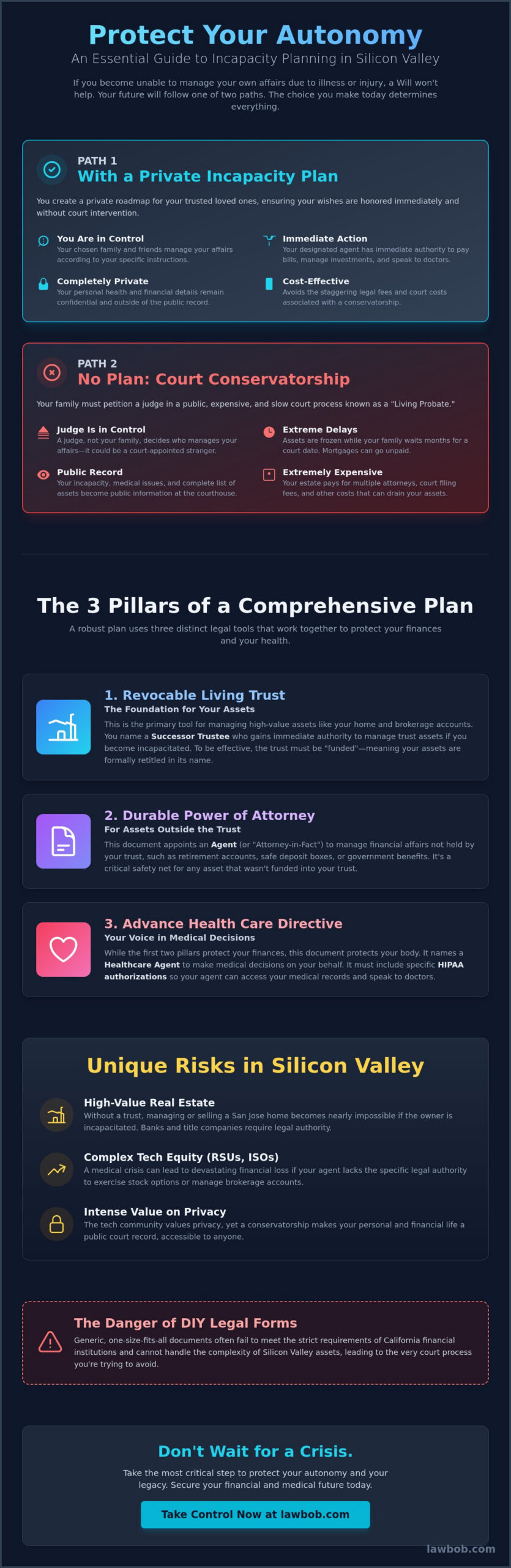
If you haven’t documented your wishes, the Santa Clara County Superior Court must step in through a process called a conservatorship. This is often referred to as “living probate” because it involves the same public scrutiny and high costs as settling an estate after death, but it happens while you are still here. Without a plan, your family must petition a judge to grant them the authority to pay your mortgage or talk to your doctors. This process is slow, expensive, and entirely avoidable with the right legal structures in place.
Legal vs. Clinical Incapacity
It’s vital to distinguish between a medical diagnosis and a legal status. Clinical incapacity is determined by healthcare professionals who assess your cognitive function or physical ability to communicate. Legal incapacity, however, is a determination made by a judge or through specific “triggering events” defined in your legal documents. In a standard Silicon Valley estate plan, we often use a Power of Attorney that requires one or two physicians to certify in writing that you can no longer manage your affairs. This mechanism ensures your plan only activates when it’s truly necessary, protecting you from a premature loss of control over your own life.
Why Silicon Valley Residents Face Unique Risks
Living in the heart of the tech world introduces complexities that standard DIY forms simply can’t handle. Managing high-value San Jose real estate without a trust is nearly impossible if the owner is incapacitated. Banks and title companies often refuse to recognize informal arrangements or outdated documents. For professionals with stock options, RSUs, or ISOs, a medical crisis can lead to devastating financial loss. If there’s no legal authority to exercise options or manage brokerage accounts during a medical leave, your portfolio could suffer. Additionally, the tech community values privacy. Without private planning for incapacity in Santa Clara, your personal health details and financial status become part of the public record at the local courthouse, where anyone can access them.
The Three Pillars of a Comprehensive Incapacity Plan
A comprehensive safety net doesn’t rely on a single document. Instead, it uses three distinct legal pillars that work in tandem to cover every aspect of your life. When you engage in planning for incapacity in Santa Clara, you’re creating a fail-safe system that protects your real estate, your retirement accounts, and your physical well-being. These documents ensure that if a medical crisis occurs, your life doesn’t grind to a halt while your family waits for a court date.
Revocable Living Trusts: The Silicon Valley Gold Standard
For most residents, the Revocable Living Trust is the foundation of their plan. It’s the primary vehicle for managing high-value assets like your San Jose home and your brokerage accounts. Within the trust, you name a Successor Trustee. This individual has the immediate legal authority to step in and manage trust assets the moment you’re unable to do so. To make this transition seamless for local banks and title companies, you’ll often provide a Certification of Trust. This condensed document proves the trustee’s authority without revealing your private distribution wishes. Keep in mind that a trust only works if it’s “funded.” This means you must formally retitle your assets into the name of the trust. If an asset remains in your individual name, your trustee cannot touch it without a court order.
Advance Health Care Directives and HIPAA
While the trust handles the money, your Advance Health Care Directive handles your body. This document allows you to name a “Healthcare Agent” who will make medical decisions if you’re unconscious or cognitively impaired. In Santa Clara County, it’s particularly important to include specific HIPAA authorizations. Without these, federal privacy laws may prevent doctors at facilities like Stanford Health Care or Kaiser Permanente from sharing vital information with your family. Your directive also codifies your end-of-life wishes under California law, ensuring your personal values are respected even when you can’t voice them.
The final piece is the Durable Power of Attorney for Property. This covers everything the trust doesn’t, such as your 401k, Social Security benefits, and tax filings. By integrating these three pillars, planning for incapacity in Santa Clara becomes a robust shield for your family. Together, these tools ensure that no part of your life is left to chance. If you’re ready to build this defensive structure, exploring a Revocable Living Trust is a logical first step toward total security.
Private Planning vs. Santa Clara County Conservatorship
If you don’t have a plan in place, the state of California has one for you. It’s called a conservatorship. This is a court-supervised process where a judge in the Santa Clara County Superior Court picks a person to manage your life and finances. While it sounds like a safety net, it’s actually a significant loss of personal liberty. You lose the right to choose who cares for you, where you live, and how your money is spent. Planning for incapacity in Santa Clara allows you to bypass this intrusive process entirely, keeping your private life out of the public record.
Conservatorships are public by nature. Every detail of your medical condition and your Silicon Valley assets becomes part of a file that anyone can view at the courthouse. Additionally, there is a “Conservatorship Tax” that most families don’t anticipate. This includes the $435 filing fee for a new petition in Santa Clara County, plus high legal fees for multiple attorneys, court-appointed investigators, and bond premiums that must be paid annually from your estate. These costs quickly drain the resources meant for your care.
The Cost and Delay of Court Intervention
Court intervention isn’t fast. While an emergency petition might be heard in a matter of weeks, a general conservatorship in Santa Clara County often takes several months to finalize. During this time, the court sends an investigator to your home to interview you and your family. They’ll also appoint an attorney to represent you, even if you already have family members willing to help. Once the court is involved, the conservator must file public accountings of every penny spent. This level of oversight is rigid and can be incredibly frustrating for your loved ones who are already dealing with a medical crisis.
Why a Durable Power of Attorney is the Better Alternative
Choosing a private solution is almost always the better path. Compare the manageable, one-time cost of a Durable Power of Attorney to the thousands of dollars in ongoing court costs and filing fees. A well-drafted plan makes court intervention unnecessary in 99% of cases. It keeps your family in the living room and out of the courtroom. By documenting your wishes now, you ensure that your spouse or child has the immediate authority to act. This private planning for incapacity in Santa Clara maintains your dignity and protects your assets from the “living probate” of the court system.
Protecting High-Value Assets: Real Estate and Equity
Managing high-value assets requires more than a standard template. In Silicon Valley, your wealth is often tied up in complex real estate and equity packages that require specific legal handling. Effective planning for incapacity in Santa Clara ensures these assets don’t freeze during a medical crisis. Without the right documents, your family might find themselves unable to access the very resources meant to pay for your care.
Real Estate Management in Santa Clara
Many San Jose homeowners believe being married automatically gives them the right to sell or refinance their home if their partner becomes ill. This is a dangerous misconception. Title companies and lenders require the signature of both owners for any major transaction. If one partner cannot sign due to a medical emergency, the other is stuck unless they have a trust or a power of attorney. Sometimes, a home is accidentally left out of a trust during a refinance. In these specific cases, we may use a Heggstad Petition to ask the court to recognize the home as a trust asset, though it’s much safer to title it correctly today. You should also avoid the “shortcut” of adding children to your deed. This move can trigger unnecessary gift taxes and expose your home to your children’s personal creditors or legal judgments.
Equity and Tech Portfolios
Your tech portfolio presents a unique challenge that many general practitioners overlook. Restricted Stock Units (RSUs) and Incentive Stock Options (ISOs) are often the largest part of a Silicon Valley professional’s net worth. These assets are frequently time-sensitive. If you’re on a medical leave and unable to make decisions, your family needs the legal authority to exercise options before they expire. A robust strategy for planning for incapacity in Santa Clara must include a Durable Power of Attorney with specific language granting your agent the power to manage these complex equity instruments. This authority should also extend to digital assets and cryptocurrency, which require specific legal permissions for your agent to access and manage securely.
Titling also impacts your future taxes through the “step-up in basis.” If you transfer property incorrectly to avoid probate, you might accidentally lose this tax benefit, which resets an asset’s value to its current market price upon death. This can lead to massive capital gains taxes for your heirs. We coordinate with your financial advisor to ensure your legal documents and account titles are perfectly aligned. If you’re a tech professional or entrepreneur, securing these high-value assets is a priority. Reach out to discuss how Asset Protection Planning can safeguard your portfolio against the unexpected.
Implementing Your Plan with a Certified Specialist
Creating a legal document is only half the battle. The true test of your strategy happens when a third party, like a bank or a hospital, is asked to honor it. Many residents who rely on “DIY” online forms discover too late that these templates often fail under the strict scrutiny of California financial institutions. Banks are notoriously cautious about accepting a Power of Attorney that lacks specific, state-mandated language or looks like a generic download. When you prioritize planning for incapacity in Santa Clara, you need documents that are drafted to withstand the rigorous standards of local institutions and the California Probate Code.
Working with a State Bar of California Certified Specialist in Estate Planning, Trust, and Probate Law provides a level of security that general practitioners simply cannot offer. This designation is held by less than one percent of California attorneys and requires extensive experience, peer reviews, and rigorous testing. Robert P. Bergman uses over 40 years of local experience to ensure your plan is legally sound and practically executable. By building a plan with a seasoned mentor, you avoid common pitfalls that lead to the very court intervention you’re trying to prevent.
The Importance of Specialized Legal Guidance
General practitioners often miss the niche requirements of the Santa Clara County Superior Court or the specific administrative hurdles faced by family members. Our firm focuses exclusively on non-litigated estate matters, which means we design plans intended to keep your family out of conflict. We also provide Trustee Advisory Services to guide your named agents through their roles. This mentorship ensures that your spouse or children understand exactly how to use the legal authority you’ve given them, reducing their stress during an already difficult time.
Start Your Santa Clara Incapacity Plan Today
The most critical element of planning for incapacity in Santa Clara is timing. You must have the legal “capacity” to sign these documents. Once a medical crisis or cognitive decline has progressed too far, it’s often too late to create a private plan, leaving a court-ordered conservatorship as the only remaining option. We believe in transparency and predictability, which is why we utilize a fixed-fee model. This allows you to focus on the design of your plan without worrying about unpredictable hourly billing or hidden costs.
The process begins with a comprehensive consultation where we map out your Silicon Valley assets and personal wishes. We’ll help you select the right agents and draft the precise language needed to protect your autonomy. Don’t leave your future to the discretion of a judge. Schedule a consultation with Robert P. Bergman to secure your future today.
Take Control of Your Future and Financial Security
Securing your medical and financial autonomy is one of the most significant gifts you can give to yourself and your family. By planning for incapacity in Santa Clara, you ensure that your high-value Silicon Valley assets, from RSUs to San Jose real estate, remain under the control of those you trust most. You’ve seen how a comprehensive strategy using a Revocable Living Trust and Power of Attorney keeps your private life out of the public record and avoids the “living probate” of a court-supervised conservatorship. This proactive approach replaces the anxiety of the unknown with a clear, instructional roadmap for your future care.
Robert P. Bergman is a State Bar of California Certified Specialist with over 40 years of local experience navigating the specific legal landscape of Santa Clara County. Our firm prioritizes transparency and predictability, utilizing fixed-fee models so you know exactly what to expect from the start. It’s never too early to build your defensive safety net, but it can quickly become too late. Take the first step toward total peace of mind today. Request a Consultation with a San Jose Estate Planning Specialist to begin designing a custom plan that protects everything you’ve worked so hard to build.
Frequently Asked Questions
What is the difference between a Will and incapacity planning in California?
A Will only takes effect after your death, while incapacity planning provides legal instructions for your care and finances while you are still alive. If you become unconscious or cognitively impaired, a Will offers no help. Incapacity planning uses tools like trusts and powers of attorney to authorize trusted individuals to pay your bills and make medical choices on your behalf during a medical crisis.
Does my spouse automatically have Power of Attorney if I become incapacitated?
No, a spouse does not automatically have the legal authority to manage your individual accounts or sign your name on legal documents. Without a formal Durable Power of Attorney or being named as a co-trustee, your spouse may be blocked from accessing your retirement accounts or selling community property. They would likely need to petition the court for a conservatorship to gain the authority they need.
How much does a conservatorship cost in Santa Clara County?
A conservatorship involves significant upfront and ongoing costs, starting with a $435 filing fee for a new petition in Santa Clara County Superior Court. Beyond the filing fee, you must pay for court-appointed investigators, attorneys for the proposed conservatee, and annual bond premiums. These legal expenses are paid out of your estate and can easily reach thousands of dollars, making private planning a much more cost-effective choice.
Can I change my incapacity documents if I recover from an illness?
Yes, you can amend or revoke your incapacity documents at any time as long as you have the legal capacity to do so. If you recover from a temporary illness or simply change your mind about who should serve as your agent, you can update your Revocable Living Trust or Power of Attorney. It is best to review these documents every few years to ensure they still reflect your current wishes.
What happens to my San Jose home if I don’t have an incapacity plan?
Your San Jose home could be effectively frozen if you become incapacitated without a trust or Power of Attorney. If a sale or refinance is needed to pay for your care, your spouse or family cannot sign for you. They would be forced into a public conservatorship process to get a judge’s permission to manage the property. This is why planning for incapacity in Santa Clara is vital for protecting real estate.
Is a Power of Attorney still valid after I pass away?
No, a Power of Attorney legally expires the moment you pass away. Once death occurs, the authority to manage your affairs shifts to the Executor named in your Will or the Successor Trustee of your Revocable Living Trust. This is why a complete plan includes both incapacity documents for your lifetime and estate documents for after your death to ensure a seamless transition for your family.
What are the risks of using a generic Power of Attorney form in Silicon Valley?
Generic forms often lack the specific legal language required to manage complex Silicon Valley assets like RSUs, ISOs, or digital accounts. California banks are often hesitant to honor “DIY” documents that don’t meet strict state requirements. A generic form might leave your family unable to exercise stock options during a medical leave, leading to significant financial losses that a specialized plan would have prevented.
Who should I choose as my healthcare agent in Santa Clara?
You should choose someone who is calm under pressure, understands your personal values, and is willing to follow your medical instructions. While many people choose a spouse or adult child, it’s important to pick someone who can communicate effectively with doctors at local facilities like Stanford Health Care. Effective planning for incapacity in Santa Clara involves having honest conversations with your agent before a crisis occurs.

Article by
Robert P. Bergman
Bob Bergman has been a Board Certified Specialist in Estate Planning, Trust and Probate Law since 2011, as certified by the California State Bar Board of Legal Specialization. For over 40 years, Bob has assisted families in Santa Clara County and the greater San Francisco Bay Area with estate planning, trust administration, and specialty court petitions involving trusts. Bob is friendly, very approachable, and believes in explaining complex legal topics in clear ordinary language so that his clients understand exactly what they're doing and why they're doing it.
Disclaimer
This article is for informational purposes only. Nothing in this article is intended to replace legal advice from a competent attorney. Nobody should rely on information in this article in making legal decisions without such consultation.