
In California, acting as a successor trustee isn’t just a family honor; it’s a high-stakes legal role where a single missed deadline can lead to personal financial liability. You’ve likely stepped into this position during a difficult time of loss, only to find yourself buried under the weight of the California Probate Code and the expectations of anxious heirs. It is completely normal to feel overwhelmed by the complexity of managing a Silicon Valley estate or the pressure of the 60-day notice requirement. This successor trustee duties checklist California is designed to replace that anxiety with a clear, professional roadmap for 2026.
We’ll help you master your legal obligations by breaking down every statutory requirement, from the newly reinstated Medi-Cal asset tests to the updated 2026 notice rules for child support services. You’ll learn how to protect yourself from legal claims while efficiently transferring assets, including high-value real estate, to the rightful beneficiaries. This guide provides a chronological, step-by-step compliance checklist that ensures you meet every fiduciary duty with confidence and precision. By following this expert roadmap, you can transform a complex legal burden into a manageable and protected process.
Key Takeaways
- Identify the critical first steps to take within 30 days, including how to secure original estate documents and establish your authority as the legal manager of the trust.
- Understand your statutory obligations under the California Probate Code to notify heirs and state agencies within strict 60-day deadlines to avoid legal complications.
- Utilize this successor trustee duties checklist California to properly value complex assets like Silicon Valley real estate and obtain a new Federal Tax ID for the trust.
- Protect yourself from personal financial liability by following the correct procedures for settling decedent debts and filing required fiduciary tax returns in 2026.
- Learn why you should never distribute funds until you have a signed “Receipt and Release” agreement to shield yourself from future claims by beneficiaries.
Immediate Actions: The First 30 Days of Successor Trusteeship
The first thirty days of your administration are often a whirlwind of grief and administrative pressure. As you begin this journey, it’s vital to understand your new identity. You aren’t just a family member anymore; you’ve become a fiduciary. This means you have a legal obligation to act in the best interests of the beneficiaries, putting their needs above your own. To get started, you might find it helpful to review the foundational legal definition of What is a Trust? to ground yourself in these new responsibilities.
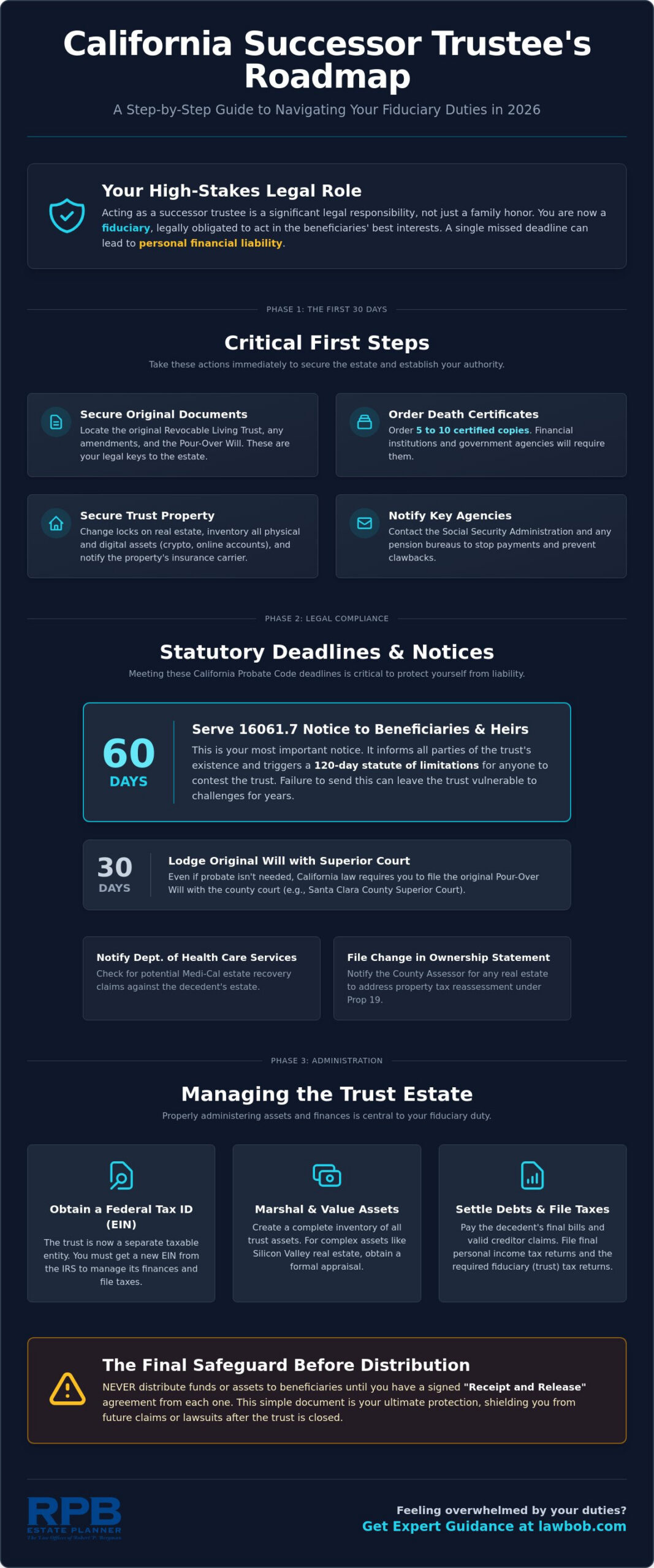
Starting your administration with a comprehensive successor trustee duties checklist California helps ensure you don’t miss critical statutory windows. Your immediate priority is locating and securing the original estate planning documents. You’ll need the Revocable Living Trust, any numbered amendments, and the original Pour-Over Will. These aren’t just papers; they’re your legal keys to the estate. Without the originals, you might face significant delays or even be forced into court to prove the trust’s validity.
Order at least 5 to 10 certified copies of the death certificate immediately. While it seems like a lot, you’ll find that financial institutions, life insurance companies, and the County Recorder for Silicon Valley real estate transfers almost always require an original certified copy. Digital scans rarely suffice for high-value transactions. You should also take immediate steps to protect trust property. For real estate in areas like San Jose or Santa Clara, this means changing the locks to control access and notifying the insurance carrier that the property is now held in trust. This prevents a lapse in coverage that could leave you personally liable if a claim arises.
Gathering the Foundational Legal Paperwork
Review the trust document for specific instructions regarding funeral wishes and immediate cash needs for the family. You’ll also need to identify all named beneficiaries and gather their current contact information to meet your legal notice requirements. Ensure you have a ‘Certification of Trust’ ready; this is a shortened version of the trust that allows you to prove your authority to banks without revealing private distribution details.
Securing Physical and Digital Assets
Inventorying tangible personal property like jewelry, art, and vehicles is a critical defensive step to prevent family looting or accidental loss. In 2026, a trustee must also identify digital footprints. This includes accessing cryptocurrency wallets and digital accounts early in the process. Finally, notify the Social Security Administration and any pension bureaus to stop payments, as these agencies will eventually claw back any funds issued after the date of death.
California Probate Code Compliance: Mandatory Legal Notices
Once you’ve secured the physical property and documents, your focus must shift to the strict legal deadlines mandated by the California Probate Code. Meeting these requirements is the most effective way to shield yourself from personal liability. The most critical item on any successor trustee duties checklist California is the 16061.7 Notice. This isn’t just a courtesy; it’s a statutory obligation to notify all heirs and beneficiaries within 60 days of the trust becoming irrevocable, which typically occurs upon the settlor’s death. Failing to send this notice properly can leave the trust open to challenges for years, whereas a correctly served notice triggers a 120-day statute of limitations for trust contests.
Beyond the beneficiaries, you must also interface with several government entities. You’re required to notify the California Department of Health Care Services (DHCS) to determine if there are any Medi-Cal estate recovery claims. Even if you believe probate isn’t necessary because the assets are in a trust, California law requires you to “lodge” the original Will with the Santa Clara County Superior Court within 30 days of the death. Additionally, for any real estate held in the trust, such as a family home in San Jose, you must file a “Change in Ownership Statement” with the County Assessor to address property tax reassessment issues under Proposition 19.
Executing the 16061.7 Notice Correcty
- Step 1: Identify all parties. You must send the notice to every beneficiary named in the trust and every legal heir who would have inherited if there were no trust.
- Step 2: Use mandatory language. The notice must include specific “warning” text in 10-point boldface type as required by the Probate Code.
- Step 3: Serve via certified mail. Always send these notices with a return receipt requested and keep the proof of service in your permanent trust records.
Managing Government Agency Notifications
You must report the death to the Franchise Tax Board (FTB) to close out the decedent’s tax history and avoid unexpected penalties. If you’re managing a San Jose home, pay close attention to Proposition 19; the parent-to-child exclusion is now limited to primary residences and has strict valuation caps. Effective January 1, 2026, you must also provide notice to the California Department of Child Support Services if you have reason to believe the decedent had outstanding obligations. If these technical requirements feel daunting, seeking professional Trustee Advisory Services can provide the clarity you need to stay compliant. The 60-day notice window officially starts the 120-day statute of limitations for any beneficiary who wishes to contest the trust’s validity.
Marshaling and Valuing Assets in Silicon Valley
Once the legal notices are in the mail, your next priority is marshaling. This is the formal process of identifying, securing, and taking legal control of everything the decedent owned. This phase is a cornerstone of the successor trustee duties checklist California, as it establishes the financial foundation for the entire administration. You must obtain a Federal Tax ID Number (EIN) for the trust immediately. From the moment of death, the decedent’s Social Security number is no longer valid for trust business. Using the wrong number for interest-bearing accounts can lead to IRS penalties that are difficult to untangle later.
In Silicon Valley, where median home prices in Santa Clara County are forecasted to increase by 3-5% by the end of 2026, getting a professional date-of-death appraisal is your most important tax-saving tool. This ‘Step-Up in Basis’ adjusts the asset’s value to its fair market price on the day the settlor passed away. For a San Jose family home purchased decades ago, this adjustment can save heirs hundreds of thousands of dollars in future capital gains taxes. Without a formal 2026 appraisal, the IRS may challenge the valuation, potentially costing the beneficiaries their inheritance through unnecessary taxation.
Inventorying the estate goes beyond real estate. You need to create a comprehensive list of bank accounts, brokerage accounts, and business interests. Retitling these assets is a technical process that involves moving accounts from the decedent’s name into your name as the Successor Trustee. Banks will require a certified death certificate and a specific legal summary of your powers to complete these transfers.
Valuing Real Estate and Business Interests
Hiring a qualified appraiser familiar with local markets like Los Gatos or Palo Alto is essential for accuracy. Tech-heavy estates often include ‘closely held’ business interests or stock options that require specialized valuation experts. During this stage, perform a Certification of Trust review to ensure all these complex assets were properly funded into the trust. If an asset was left in the decedent’s individual name, you may need to discuss a Heggstad Petition with your legal advisor to avoid a full probate.
Consolidating Financial Accounts
Open a dedicated Trust Checking Account to handle all estate income and expenses. Never mix trust funds with your personal money; this ‘commingling’ is a direct breach of your fiduciary duty and a common source of litigation. Transfer liquid funds from the decedent’s accounts into this new trust account to cover property taxes, insurance, and professional fees. You must also track ‘Income in Respect of a Decedent’ (IRD), such as final bonuses or retirement distributions, which carry unique tax reporting obligations for the trust’s 1041 tax return.
Settling Debts, Taxes, and Fiduciary Accounting
Settling the financial obligations of the trust is where many trustees feel the most pressure. To protect yourself, your successor trustee duties checklist California must prioritize a methodical approach to debt resolution. You aren’t personally responsible for the decedent’s bills, but you can become liable if you distribute trust assets to heirs before legitimate creditors are satisfied. Under California law, creditors generally have one year from the date of death to file a claim if you don’t use the optional formal notice procedure. By choosing to use the optional trust claims procedure, you can shorten this window to just four months from the first publication of notice, providing a much faster path to legal safety.
The 2026 tax landscape requires careful navigation, especially for high-value Silicon Valley estates. While California does not have a state estate tax or inheritance tax, the federal estate tax exemption for individuals is $15 million in 2026. For married couples, this exemption reaches $30 million. If the estate exceeds these thresholds, you must file a federal estate tax return. Regardless of the estate’s size, you’re responsible for filing the decedent’s final individual 1040 tax return and the trust’s 1041 fiduciary tax return for any income earned by assets after the date of death.
Fiduciary accounting is your best defense against demanding or suspicious beneficiaries. A formal accounting is a detailed, chronological report of every dollar that entered or left the trust since the date of death. Providing this level of transparency often prevents the confusion and mistrust that leads to litigation. While the law requires a specific format for court-supervised trusts, most private trust administrations can use a detailed ledger to satisfy the beneficiaries’ right to information.
The Fiduciary Accounting Requirement
Start a digital or physical ledger on day one. You must record every receipt and disbursement, no matter how small the amount. A common pitfall for new trustees is commingling trust funds with personal bank accounts; even if done accidentally to pay a quick bill, this is a major breach of your duties. To streamline the closing process, you can ask beneficiaries to sign ‘Waivers of Account,’ which confirms they’ve received sufficient information and agree to skip the formal reporting process to receive their inheritance faster.
Tax Compliance and Professional Coordination
Coordinate closely with a CPA to ensure all California and federal filings are accurate. You may want to file a ‘Request for Prompt Assessment,’ which can shorten the IRS’s window to audit the decedent’s past returns from three years down to 18 months. Paying a disputed debt too early can be a breach of fiduciary duty because it reduces the inheritance available to beneficiaries without a proven legal necessity. If you need professional guidance to manage these complex financial steps, our Trust Administration services ensure every statutory box is checked correctly.
Final Distribution and Closing the Trust
The final stage of your journey is the distribution of assets. This is the moment beneficiaries have been waiting for, but as a fiduciary, you must remain disciplined until the very end. Your successor trustee duties checklist California concludes with a formal Plan of Distribution. This document aligns the trust’s remaining assets with the specific percentages or dollar amounts outlined in the original document. You’ll need to decide whether to distribute assets ‘in-kind’ or liquidate them first. For instance, if the trust holds a family home in San Jose, do the heirs want the deed transferred to them, or should you sell the property and distribute the cash? This decision often depends on the heirs’ financial goals and their ability to manage property taxes under current California regulations.
Before you sign a single check or transfer a deed, you must obtain a signed ‘Receipt and Release’ agreement from every beneficiary. This is perhaps the most vital legal shield in your entire administration. By signing this, the beneficiary acknowledges they’ve received their full inheritance and, more importantly, releases you from any future liability related to your management of the trust. Without this document, a beneficiary could potentially sue you years later, even after the money has been spent. If the trust requires the creation of ‘sub-trusts’ for minors or involves Special Needs Trusts, those assets must be moved into new, separate accounts rather than being paid out directly.
Executing the Transfer of Assets
For real property transfers, you must record new deeds with the Santa Clara County Recorder to officially move the title out of the trust and into the names of the heirs. Distribute specific bequests, such as jewelry or family heirlooms, as the first step in the physical transfer process. Always obtain a signed receipt for these items to maintain your records. The ‘residue’ of the estate is what remains after all specific gifts and debts are settled; this is typically distributed as a percentage to the primary beneficiaries.
Closing the Administration
Never empty the trust bank account completely. You should establish a ‘reserve’ fund to cover final tax preparation fees, closing costs, and any unexpected tail-end expenses that might arise in the following year. This reserve protects you from having to ask beneficiaries to return money if a surprise bill arrives. Maintaining transparent communication during this final phase is the best way to preserve family harmony and prevent last-minute disputes. For many, Trustee Advisory Services are the smartest investment a first-time trustee can make. These services provide the professional oversight needed to ensure that your final acts as a trustee are as legally sound as your first.
Taking the Next Step Toward Finality and Protection
You’ve moved through the immediate 30-day hurdles and managed the intricate process of valuing Silicon Valley assets. By utilizing this successor trustee duties checklist California, you’ve replaced the fear of personal liability with a structured roadmap for 2026 compliance. Your success as a fiduciary depends on maintaining this level of precision through the final distribution, ensuring every debt is settled and every beneficiary release is signed. These steps don’t just protect the assets; they preserve your family’s legacy and your own peace of mind.
Managing these legal obligations doesn’t have to be a solitary burden. Robert P. Bergman is a Certified Specialist in Estate Planning, Trust, and Probate Law with over 40 years of California legal experience. Our firm provides the steady hand you need, offering transparent, fixed-fee models that ensure financial predictability throughout the administration process. Schedule a Trustee Consultation with Robert P. Bergman to gain the clarity that comes from professional mentorship. You’ve done the hard work of starting this process; now, let’s help you finish it with absolute confidence and legal security.
Frequently Asked Questions
How much can a successor trustee get paid in California in 2026?
Successor trustees are entitled to “reasonable compensation” for their services unless the trust document specifically states otherwise. In 2026, professional fiduciaries in California typically charge between 1% and 1.5% of the trust assets annually, or hourly rates ranging from $100 to over $250. If you’re a family member serving as trustee, you can use these professional benchmarks to determine a fair fee for the time and effort you invest in the administration.
Can a successor trustee be held personally liable for trust debts?
You aren’t personally responsible for the decedent’s debts, but you can be held liable if you handle the estate’s finances incorrectly. Liability often arises if you distribute money to beneficiaries before paying known creditors or if you “commingle” trust funds with your own bank accounts. Following a comprehensive successor trustee duties checklist California helps you follow the correct legal priority for payments, shielding your personal assets from claims by creditors or disgruntled heirs.
How long does a successor trustee have to distribute assets in California?
California law doesn’t set a strict expiration date for trust administration, but you’re required to act within a “reasonable” timeframe. Most straightforward trust administrations take between 6 and 12 months to complete. This window allows enough time to settle creditor claims, file the necessary 2026 tax returns, and ensure all legal notice periods have expired before the final checks are written to beneficiaries.
What happens if a successor trustee fails to perform their duties?
If you neglect your fiduciary duties or act in bad faith, beneficiaries can petition the probate court to have you removed from your position. The court may also “surcharge” you, which means you’d have to pay out of your own pocket to reimburse the trust for any financial losses caused by your mistakes. This is why transparency and meticulous record-keeping are your most important defensive tools during the administration process.
Does a successor trustee need to hire a lawyer for trust administration?
While you aren’t legally forced to hire an attorney, most trustees find that professional guidance is essential to avoid costly legal traps. The California Probate Code is dense and unforgiving regarding missed deadlines or improper notices. Since the trust usually pays for legal fees as a legitimate administration expense, hiring an expert ensures you meet your obligations without risking your personal financial security.
What is the 120-day rule for California trust contests?
The 120-day rule is a statutory deadline that prevents beneficiaries from challenging the trust’s validity indefinitely. Once you serve the mandatory 16061.7 notice, any person wishing to contest the trust must file their lawsuit within 120 days. If they fail to act within this window, they’re generally barred from ever challenging the trust in court, which provides you with the legal finality needed to distribute assets safely.
How do I handle a house that wasn’t put into the trust before death?
If a property was left out of the trust, you may need to file a Heggstad Petition to ask the court to “transfer” the asset into the trust retroactively. For deaths occurring after April 1, 2025, California law also offers a simplified transfer process for primary residences valued up to $750,000. This new procedure can help you avoid a full, year-long probate for homes that were accidentally left in the decedent’s individual name.
Is a successor trustee required to provide an accounting to beneficiaries?
You have a mandatory legal duty to provide a formal accounting to all “vested” beneficiaries at least once a year and before the final distribution. This report must show every penny that came into the trust and every dollar spent on debts, taxes, or fees. You can only skip this requirement if every beneficiary signs a formal waiver, but providing a clear accounting is often the best way to maintain family harmony.

Article by
Robert P. Bergman
Bob Bergman has been a Board Certified Specialist in Estate Planning, Trust and Probate Law since 2011, as certified by the California State Bar Board of Legal Specialization. For over 40 years, Bob has assisted families in Santa Clara County and the greater San Francisco Bay Area with estate planning, trust administration, and specialty court petitions involving trusts. Bob is friendly, very approachable, and believes in explaining complex legal topics in clear ordinary language so that his clients understand exactly what they're doing and why they're doing it.
Disclaimer
This article is for informational purposes only. Nothing in this article is intended to replace legal advice from a competent attorney. Nobody should rely on information in this article in making legal decisions without such consultation.