
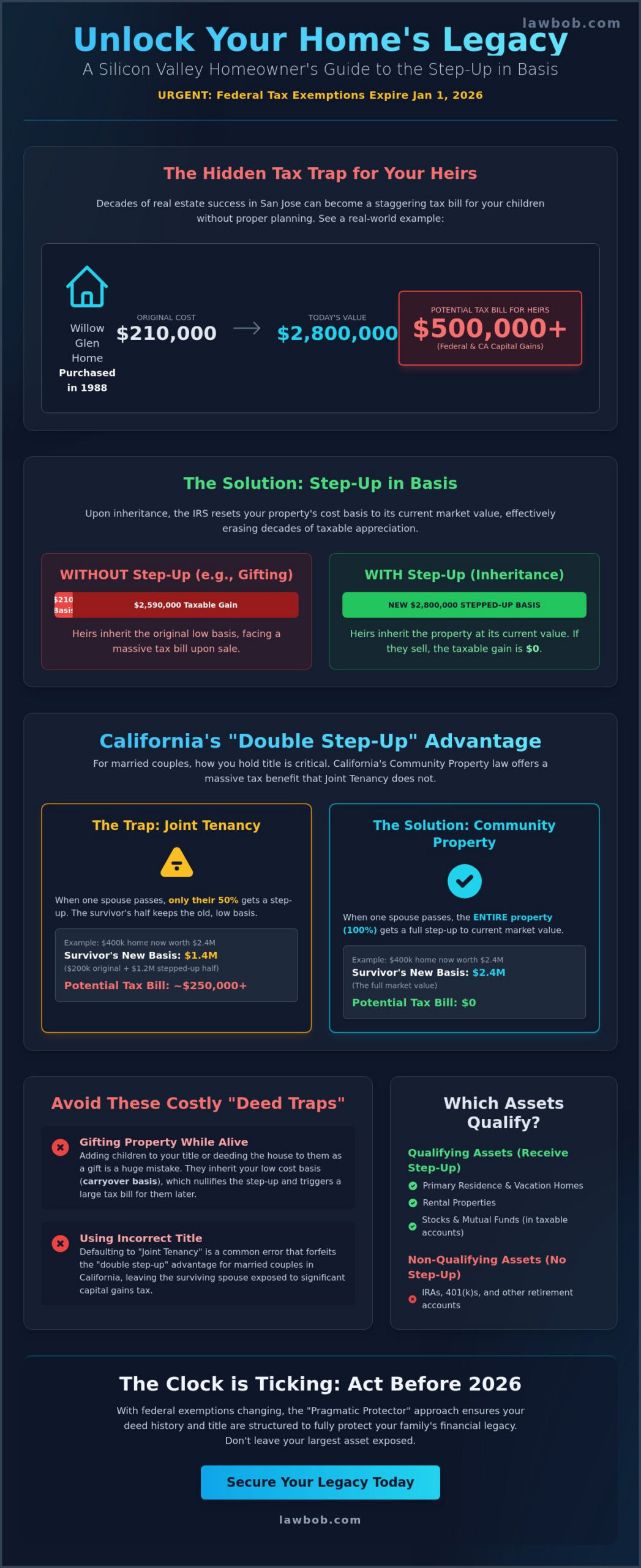
Imagine a San Jose family who purchased their Willow Glen home in 1988 for $210,000. Today, that property is valued at $2.8 million. Without a proper step up basis at the time of inheritance, their children could owe the IRS and the State of California over $500,000 in capital gains taxes. It’s a staggering figure. This tax trap catches many Silicon Valley homeowners off guard, especially with the January 1, 2026, sunset of current federal tax exemptions quickly approaching.
You want to ensure your children inherit the full value of your hard work. It’s frustrating to think that your local real estate success could become a financial burden for your heirs. Learn how to use California community property laws to minimize or even eliminate these taxes entirely. I’ll show you specific titling strategies and the critical steps you must take before the 2026 tax law changes to protect your family’s financial legacy.
Key Takeaways
- Learn how the step up basis rule can reset your property’s taxable value to its current market price, potentially saving your heirs millions in capital gains taxes.
- Discover the unique “double step-up” advantage available to California married couples and how to properly title your home to secure this massive tax benefit.
- Prepare for the 2026 sunset of current tax laws by understanding how shifting federal exemptions will change the estate planning math for Silicon Valley homeowners.
- Avoid the common “deed trap” of adding children to your title prematurely, which can accidentally trigger a costly carryover basis and high tax bills.
- Find out how Bob’s “Pragmatic Protector” approach to reviewing titles and deed history ensures your family legacy is organized and fully protected.
What is Step-Up in Basis and Why Does It Matter in San Jose?
Understanding how taxes impact your family’s future starts with one critical concept: the Stepped-up basis. When you pass away and leave a home or investment to your heirs, the IRS allows for a massive tax “reset.” This adjustment changes the asset’s value from what you originally paid, known as the cost basis, to what it’s worth on the day you died, which is the fair market value. This simple shift can save your loved ones hundreds of thousands of dollars in taxes.
Imagine you bought a home in San Jose in 1985 for $200,000. If you were to sell it today for $2 million, you would face a heavy capital gains tax on that $1.8 million profit. However, if your children inherit that same house, their new basis becomes $2 million. They could sell it immediately and owe zero in capital gains taxes. This is why a step up basis is the most powerful tool in California estate planning. It effectively wipes out decades of taxable appreciation in a single moment.
You should be careful to avoid the common “tax trap” of carryover basis. This happens when you give your home away as a gift while you’re still alive. If you sign the deed over to your kids today, they take over your original $200,000 basis. When they eventually sell the property, they’ll be stuck with a massive tax bill that could have been completely avoided with a properly structured trust. My goal is to help you keep that equity in your family’s pocket rather than sending it to the government.
The Silicon Valley Real Estate Factor
Real estate in Santa Clara County has seen explosive growth over the last 30 years. A bungalow in Willow Glen or a ranch home in Sunnyvale that cost $250,000 in the 1990s often commands a price tag of $2.5 million today. Without a step up basis, your family could lose a staggering portion of their inheritance to state and federal taxes. This reality makes estate planning vital for every homeowner in the valley, even those who consider themselves “modest” long-term residents. You don’t need to be a tech mogul to have a multi-million dollar tax problem waiting for your children.
Which Assets Qualify for a Basis Adjustment?
Not every asset in your portfolio gets this tax break. It’s important to categorize your holdings correctly so you can plan with clarity. To secure this benefit, you must obtain a formal appraisal of the property as of the date of death. This documentation serves as your proof of value if the IRS ever asks questions.
- Qualifying Assets: This includes your primary residence, vacation homes, rental properties, and stocks or mutual funds held in taxable brokerage accounts.
- Non-Qualifying Assets: Retirement accounts such as IRAs or 401(k) plans do not receive a basis adjustment. These are considered “income in respect of a decedent” and are taxed differently when withdrawn by heirs.
By organizing your estate now, you ensure that your heirs can use the full value of their inheritance to build their own lives, rather than using it to pay off a tax debt that could have been avoided.
California Community Property: The “Double Step-Up” Advantage
California is one of only a handful of states that follows a community property system. In common law states, assets are typically treated as belonging to whichever spouse holds the title. California law treats most assets acquired during a marriage as belonging equally to both partners. This legal distinction creates a massive tax benefit for San Jose homeowners. Under Internal Revenue Code Section 1014(b)(6), when one spouse passes away, the entire property receives a new Step-Up In Basis to its fair market value on the date of death. This applies even to the surviving spouse’s 50% share, effectively wiping out years of built-up capital gains taxes in a single stroke.
Joint Tenancy vs. Community Property
Many couples in Santa Clara County fall into the “Joint Tenancy” trap. They often choose this title because it’s the default option at many title companies. It allows property to pass to the survivor without probate, but it carries a heavy tax price. In a joint tenancy, only the 50% interest belonging to the deceased spouse gets a step up basis. The survivor’s half retains its original cost basis.
If you bought a home in Willow Glen in 1995 for $400,000 and it’s now worth $2.4 million, that mistake can be costly. Missing the step-up on the survivor’s half could lead to a tax bill exceeding $250,000 upon a future sale. Titling the home as “Community Property with Right of Survivorship” provides the same probate avoidance while securing the full 100% basis reset. If your property wasn’t titled correctly before a spouse passed, we can often file a Spousal Property Petition to confirm the asset’s status, but it’s much simpler to fix the deed now.
The Role of the Revocable Living Trust
Silicon Valley families use revocable living trusts to maintain control and ensure their “double step-up” is airtight. A properly funded trust preserves the community property status of your assets even if you move them into the trust’s name. Bob’s approach to drafting trusts includes specific “community property characterization” language. This tells the IRS exactly how the assets should be treated for tax purposes.
- Trusts avoid the public and expensive probate process.
- They ensure the step up basis occurs at the first death and again at the second death.
- They provide a clear roadmap for heirs to manage high-value San Jose real estate.
Using a trust isn’t just about who gets the house; it’s about how much of the house’s value they actually get to keep. You can find more resources on protecting your equity at lawbob.com to see how these strategies provide clarity for your estate. Bob focuses on creating tailored plans that act as a shield for your family’s financial future as we approach the 2026 tax shifts.
Basis Planning in the 2026 Estate Tax Environment
Families in San Jose face a unique financial crossroad as we approach January 1, 2026. The Tax Cuts and Jobs Act (TCJA) provisions are scheduled to sunset, which will trigger a major shift in how we approach estate planning. Currently, in 2024, the federal estate and gift tax exemption sits at a historically high $13.61 million per individual. When 2026 arrives, this limit is projected to drop to approximately $7 million after inflation adjustments. For many Silicon Valley homeowners, this “exemption cliff” turns what was once a simple plan into a complex tax calculation.
You might feel a sense of urgency to gift your property to your children now to take advantage of the current high exemption. While gifting removes the asset from your taxable estate, it often forces your heirs to accept a “carryover basis.” This means they inherit your original purchase price. In a market like San Jose, where a home bought for $200,000 in the 1980s is now worth $2.5 million, gifting now could lead to a massive capital gains tax bill later. By choosing to hold the asset until death, your heirs receive a step up basis to the property’s fair market value, potentially wiping out millions in taxable gains. For most local families, the tax savings from the basis adjustment far outweigh the benefits of early gifting.
The 2026 Exemption Cliff
The 2026 sunset creates a “use it or lose it” dilemma for estates valued between $5 million and $15 million. If you don’t utilize the current $13.61 million exemption ($27.22 million for married couples) before the deadline, that extra tax-free “space” vanishes. This puts San Jose families with multiple properties or significant tech equity at the highest risk. We help you analyze whether the 40% estate tax hit on amounts over the future $7 million threshold is more or less expensive than the capital gains your children would pay without a step up basis.
Advanced Strategies: SLATs and QTIPs
To navigate these changes, we often implement specialized trusts that offer both protection and tax efficiency. A Spousal Lifetime Access Trust (SLAT) is a powerful tool that allows you to move assets out of your taxable estate while still giving your spouse access to the trust’s income. This “locks in” today’s high exemption without completely losing control of the funds.
For married couples, we also look at QTIP trusts. These are designed to provide for a surviving spouse while ensuring the assets eventually pass to the children. A well-structured QTIP can be used to secure a second step-up in cost basis upon the death of the second spouse. These aren’t just “big city” legal maneuvers; they’re essential tools for any San Jose family looking to maintain their legacy in a changing tax landscape.
Common Mistakes That Kill Your Step-Up in Basis
The number one mistake San Jose homeowners make is adding their children’s names to a property deed while the parents are still living. Many families do this to “avoid probate,” but they often trigger a tax disaster instead. When you add a child to your deed, you aren’t just sharing the home; you’re making a gift. This results in a carryover basis. This means the child receives your original purchase price as their tax basis rather than the current market value.
If you bought your Willow Glen home in 1998 for $400,000 and it’s worth $2.2 million today, adding your daughter to the deed now forces her to keep that $400,000 basis. When she eventually sells, she’ll owe capital gains on that $1.8 million gap. If she had inherited the home after your passing, she would have received a step up basis to the full $2.2 million, potentially saving her over $400,000 in taxes. Additionally, these transfers can trigger a requirement to file a federal Gift Tax Return (Form 709).
Another frequent error is the “pocket deed.” Some owners sign a deed and tell their children to record it only after they die. California courts and the IRS often view these unrecorded deeds as invalid transfers. If the deed isn’t legally effective at the right time, the tax benefits vanish. To protect your family, you must also secure a formal professional appraisal within 6 to 9 months of a death. Without a certified valuation from that specific window, the IRS may challenge the new basis, leading to expensive audits and disputes.
The Danger of “DIY” Estate Planning
Online form-wills and generic templates often fail because they don’t account for California’s unique community property laws. In San Jose, how you title your property is everything. A common “DIY” mistake is accidentally transmuting community property into separate property. One local family lost a significant portion of their step up basis because their generic online trust labeled their home as “joint tenants” instead of “community property.” This simple clerical error, made to save a few dollars on legal fees, resulted in a tax bill exceeding $150,000 when the first spouse passed away. These generic forms don’t provide the “Pragmatic Protector” guidance you need to navigate California’s complex tax landscape.
Failing to Fund the Trust
A living trust is a powerful tool, but it’s useless for basis planning if the house isn’t “in” the trust. We call this “funding.” If you sign the trust documents but never record a deed transferring the home into the trust’s name, the asset remains outside your plan. When this happens, your heirs might be forced into probate court. While I often use a Heggstad Petition to “rescue” these forgotten assets and prove they were intended for the trust, this court process is an avoidable expense. Preventing the problem with proper deed recording is always cheaper and faster than a court petition. If you aren’t sure if your home is properly titled, it’s time to schedule a review of your estate plan to ensure your protection is locked in.
How a San Jose Estate Planning Attorney Secures Your Legacy
Bob’s process begins with a meticulous review of your property titles and deed history. In Silicon Valley, where real estate values have skyrocketed since 2014, even a small clerical error in how a title is held can jeopardize your family’s ability to claim a full step up basis. As a Pragmatic Protector, Bob focuses on creating legal structures that are clear, organized, and tax-efficient. He ensures your trust isn’t just a stack of papers but a functional tool that fits your life and protects your heirs. The Law Offices of Robert P. Bergman operates on a Flat-Fee model for creating tailored estate plans. This transparency removes the stress of hourly billing and allows you to focus on making the best decisions for your family. Working with a State Bar Certified Specialist provides the peace of mind that your legacy is handled by a recognized expert who has met rigorous education and experience requirements in California probate law.
Tailored Silicon Valley Solutions
Local expertise in Santa Clara County matters because probate procedures and local tax assessments require specific procedural knowledge. Bob acts as a mentor for his clients, drawing on 40 years of experience navigating California legal shifts. He’s helped families through the transition of Proposition 13 and the more recent changes brought by Proposition 19. This deep history allows him to spot potential pitfalls that general practitioners might miss. You can get started with a confidential consultation at our San Jose office. We’ll look at how your assets are currently held and determine if your plan still meets your goals in today’s economic environment.
Your Next Steps for 2026
The arrival of 2026 brings significant shifts in federal tax exemptions. It’s a critical time to ensure your current trust is fully compliant with these new standards. To prepare for an estate planning review, gather the following documents:
- Your current Living Trust and any recorded amendments.
- Recent grant deeds for all San Jose or California real estate.
- Latest statements for investment and retirement accounts.
- A list of your current beneficiaries and their legal names.
Reviewing these items now prevents a step up basis issue later. Don’t wait until the deadline to find out your plan is outdated or lacks the necessary language to protect your heirs from unnecessary capital gains taxes. Schedule your Silicon Valley estate planning consultation with Bob today to gain the clarity and confidence you need for the future.
Take Control of Your San Jose Real Estate Legacy
The 2026 sunset of current federal estate tax exemptions is approaching fast. For San Jose homeowners, this means the window to optimize your estate plan is narrowing. You’ve learned how California’s community property laws offer a unique double step up basis advantage, potentially saving your heirs significant amounts in capital gains taxes. These benefits aren’t automatic. Simple errors in how you title your property or structure your living trust can lead to expensive IRS audits or lost tax savings.
Bob Bergman has been practicing law in Silicon Valley since 1980. As a State Bar of California Certified Specialist in Estate Planning, he understands how to navigate the specific complexities of the Santa Clara County real estate market. With transparent flat-fee pricing, you’ll know exactly what to expect as you build a plan that fits your life. Don’t leave your family’s financial future to chance when the tax laws shift.
Secure your family’s tax-free inheritance; consult with Bob Bergman in San Jose today
You can move forward with the clarity and confidence that your legacy is organized and fully protected.
Frequently Asked Questions
Is there a step-up in basis for property in a Revocable Living Trust?
Yes, property held in a revocable living trust is eligible for a step-up in basis upon the grantor’s death. Because the grantor retains control over the assets during their lifetime, the IRS considers these assets part of the taxable estate. This allows the cost basis to reset to the fair market value as of the date of death. It effectively eliminates capital gains taxes on appreciation that occurred during the grantor’s life.
Do I get a step-up in basis if I inherit my parents house in California?
You generally receive a step-up in basis when you inherit a California home from your parents. This adjustment resets the property’s value to its market price on the date of your parent’s passing. If your parents bought a San Jose home in 1985 for $150,000 and it’s worth $1.8 million in 2026, your new basis becomes $1.8 million. This eliminates the tax on that $1.65 million gain.
What happens to the cost basis of a house when a spouse dies in a community property state?
In California, a community property state, the entire property receives a double step up basis upon the death of the first spouse. Section 1014(b)(6) of the Internal Revenue Code allows both the deceased spouse’s half and the surviving spouse’s half of the property to reset to current market value. This is a powerful benefit that isn’t available to couples in common law states, who only get a reset on the deceased spouse’s half.
Does the 2026 tax law change eliminate the step-up in basis?
The 2026 tax changes related to the sunset of the Tax Cuts and Jobs Act of 2017 don’t eliminate the step up basis. While the federal estate tax exemption is scheduled to drop from $13.61 million in 2024 to approximately $7 million in 2026, the fundamental rules for basis adjustment remain intact. You should focus on how the lower exemption affects your total estate tax liability rather than worrying about losing the basis reset itself.
How do I prove the value of an inherited asset for a basis step-up?
You prove the value by obtaining a formal appraisal from a qualified professional that reflects the fair market value on the owner’s date of death. For San Jose real estate, a certified residential appraiser provides a written report that satisfies IRS requirements. Don’t rely on property tax assessments or online estimates from 2023, as these lack the legal weight needed to substantiate your new cost basis during a tax audit.
Can I lose my step-up in basis if I sell the house too quickly?
No, you won’t lose your step-up in basis by selling the property immediately after inheritance. In fact, selling quickly often makes tax reporting simpler because the sale price serves as strong evidence of the fair market value at the time of death. If you sell the home for $2 million shortly after it was appraised at $2 million, you’ll owe zero capital gains tax on the transaction.
What is the difference between a step-up and a step-down in basis?
A step-up occurs when an asset’s value increases before death, while a step-down happens if the asset’s market value is lower than the original purchase price. If a stock was bought for $100 and is worth $150 at death, the basis steps up to $150. If it drops to $75, the basis steps down to $75. This means heirs cannot claim a capital loss on the $25 decline that occurred before they inherited it.
Is a step-up in basis available for bank accounts and IRAs?
A step-up in basis applies to bank accounts but is not available for traditional IRAs or 401(k) plans. These retirement accounts are considered Income in Respect of a Decedent under tax law. When you withdraw funds from an inherited traditional IRA, you’ll pay ordinary income tax on the distributions. However, taxable brokerage accounts and individual stocks do qualify for the basis reset, allowing you to avoid taxes on lifetime appreciation.

Article by
Robert P. Bergman
Bob Bergman has been a Board Certified Specialist in Estate Planning, Trust and Probate Law since 2011, as certified by the California State Bar Board of Legal Specialization. For over 40 years, Bob has assisted families in Santa Clara County and the greater San Francisco Bay Area with estate planning, trust administration, and specialty court petitions involving trusts. Bob is friendly, very approachable, and believes in explaining complex legal topics in clear ordinary language so that his clients understand exactly what they're doing and why they're doing it.
Disclaimer
This article is for informational purposes only. Nothing in this article is intended to replace legal advice from a competent attorney. Nobody should rely on information in this article in making legal decisions without such consultation.