
Imagine you’ve spent months or years acting as the primary caretaker for a loved one in Mountain View or Los Altos. You’ve used a legal document to pay their bills, manage their medical care, and keep their household running smoothly. It’s a heavy responsibility, and you likely assume this authority continues until the estate is settled. However, many families face a sudden and stressful roadblock when they realize that their legal standing changed the moment their loved one passed away. You need a clear answer to a vital question: does power of attorney cease on death in California? The reality is that this authority ends instantly, and continuing to use it can lead to serious legal consequences.
I understand how overwhelming it feels to manage these details while you’re grieving. You want to do the right thing for your family without accidentally committing financial fraud or mismanaging assets. This guide will provide the clarity you need to navigate this transition with confidence. You’ll learn exactly when your role as an agent expires, who takes over the baton of leadership, and how to properly protect a Silicon Valley estate using the right legal tools.
Key Takeaways
- Understand the legal reality that does power of attorney cease on death in California, ending all financial authority the moment a principal passes.
- Discover how to properly transition control to a Successor Trustee or Executor to avoid personal liability and frozen accounts.
- Learn why a Revocable Living Trust is the most effective tool for bypassing the 12 to 18 month probate process in Santa Clara County.
- Identify the legal risks of “self-dealing” and the penalties associated with using an expired document to manage estate assets.
- Explore how specialized solutions like Heggstad Petitions can protect family assets that were not formally titled in a trust.
Does Power of Attorney Cease on Death? The Definitive Answer
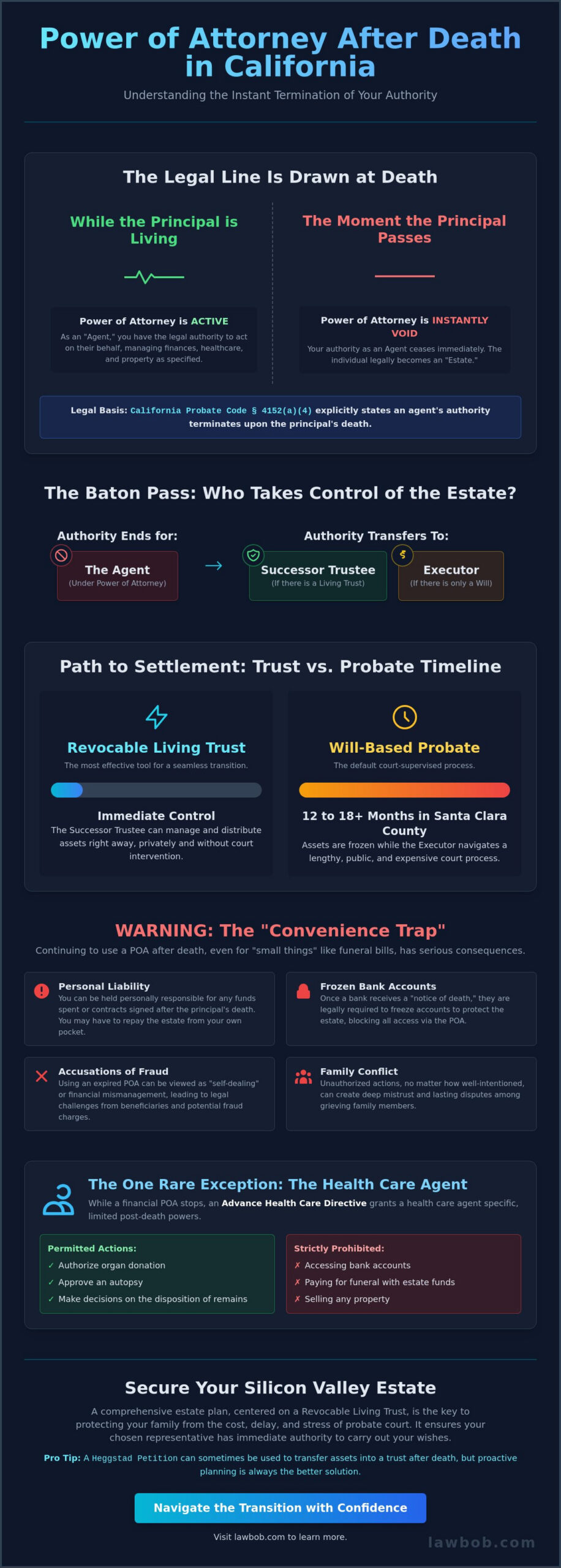
Under California law, the answer to does power of attorney cease on death is an absolute yes. This rule is codified in California Probate Code § 4152(a)(4), which states that an agent’s authority terminates the moment the principal passes away. Many people in San Jose confuse a “Durable” Power of attorney with one that lasts forever. In reality, durability only means the document remains valid if you become mentally incapacitated. It does not extend your power beyond a heartbeat. The instant a death occurs, the legal agency relationship dissolves, and the agent no longer has the right to sign documents or move money.
For an agent, also known as an attorney in fact, the consequences of ignoring this termination are serious. If you continue to act after the principal has died, you’re technically acting without legal authority. This can lead to personal liability for any funds spent or contracts signed. It can also create friction with other family members who may question your actions during a sensitive time. The law requires a clean hand off to the person named in the Will or Trust to ensure the estate is managed properly under court or trust guidelines.
The One Rare Exception: Post-Death Health Care Authority
While financial authority stops, your Advance Health Care Directive functions differently. California law allows a health care agent to retain specific, limited powers after death. This includes making decisions about the disposition of remains, authorizing an autopsy, or coordinating organ donations. It’s vital to remember that this exception is strictly medical and personal. It never grants the agent the power to access bank accounts or sell a home in Cupertino to pay for these final arrangements.
Common Misconceptions Among Silicon Valley Families
Many families fall into the “Convenience Trap,” believing they can use the existing POA to pay for funeral expenses or final utility bills. This is a mistake that can lead to legal trouble. Banks in Santa Clara County are highly sensitive to notice of death and will freeze accounts immediately to protect the estate. Once an individual dies, they become an “Estate” in the eyes of the law, requiring an Executor or Successor Trustee to take the lead. An agent is a lifetime representative, while a personal representative handles everything that comes after.
Understanding the Legal Transition: Why POA Authority Expires
To understand why the legal authority of an agent disappears, we have to look at the “Theory of Agency.” In California, an agent is simply someone standing in the shoes of a living person. When that person dies, the legal shoes effectively disappear. You might wonder, does power of attorney cease on death even if the document says it’s durable? Yes, because the law views the principal as the source of all authority. Once the source is gone, the stream of power dries up immediately. It’s a fundamental rule of law that you can’t represent someone who no longer exists as a legal “person.”
Death triggers a massive shift in how the state views property. Your loved one is no longer an individual in the eyes of the California court system; they’re now an “estate.” This new entity has different rules and protections. The court must ensure that creditors are paid and that every heir receives their fair share. This oversight prevents a single person from having unchecked control over assets that now belong to a group of beneficiaries. If you continue to act as an agent after death, you risk personal liability for any financial losses or unauthorized transactions. If you’re unsure who should be holding the baton, reviewing your estate planning documents with a professional can provide the clarity you need.
California Probate Code and the Termination of Agency
The rules aren’t just tradition; they’re codified in state law. According to California Probate Code § 4304, the death of the principal terminates the power of attorney. This statute protects third parties, like banks, if they act in good faith without “notice of death.” Notice of death is the formal or informal communication that alerts a bank or financial institution that their account holder has passed away, legally requiring them to stop honoring the agent’s signature. Once that notice is received, the bank’s legal duty shifts from following the agent’s instructions to protecting the estate’s assets.
The Shift from Agent to Trustee or Executor
Think of this transition as a baton pass in a relay race. The Durable Power of Attorney is the lifetime runner. The moment that runner crosses the finish line of life, they must hand the baton to the next person. That person is usually a Successor Trustee (if there’s a trust) or an Executor (if there’s a will). Being the agent under a POA doesn’t automatically mean you’re the one who takes over next. You must look at the specific legal documents, like a Revocable Living Trust or a Last Will and Testament, to identify who has the legal right to manage the estate from that point forward.
POA vs. Trust vs. Will: Who Takes Control After Death?
When you’re managing a home in Sunnyvale or a tech portfolio in Cupertino, you need to know exactly who has the keys to the kingdom the moment a loved one passes. Since we’ve established that the answer to does power of attorney cease on death is a firm yes, the next logical question is: who takes over? The person who held the power of attorney is effectively benched. They can no longer sign for the sale of a house or move funds between accounts. Control now shifts to either a Successor Trustee or an Executor, depending on how the estate was planned. There are several Things You Need To Know About Power Of Attorney, but the most vital is that it’s a lifetime tool that must hand off the baton to a “death tool” like a Trust or a Will.
The Successor Trustee Advantage in Silicon Valley
Learn how a Revocable Living Trust provides the most seamless transition for families. If your loved one’s assets were properly titled in a Trust, the Successor Trustee steps in immediately. There’s no “gap” in authority. This is a massive advantage for managing high-value Silicon Valley real estate where delays can lead to missed market opportunities or frozen accounts. Bob consistently recommends a Trust for anyone owning real estate in Santa Clara County. It keeps the transition private and avoids the 12 to 18 month delay common in the local court system. The Successor Trustee has the immediate legal standing that a POA agent loses the moment a heartbeat stops.
When Probate is Unavoidable: The Executor’s Role
If there’s only a Will, or no plan at all, the transition is much slower. An agent under a POA cannot simply start acting as the Executor. You must petition the Santa Clara County Probate Court for “Letters Testamentary.” This is the official document that grants you the legal right to handle the estate. This process can take months just to get a first hearing. While a Trust is private, probate is a public process. Every detail of the assets and debts becomes a matter of public record. For estates valued over the $208,850 small estate threshold, this court oversight is mandatory. You must wait for the court’s seal of approval before you can pay a single creditor or distribute a dime to heirs.
What to Do if an Agent Continues to Use a POA After Death
If you suspect a family member or friend is still using a document that has legally expired, you must act quickly to protect the inheritance. Since the answer to does power of attorney cease on death is an absolute yes, any action taken by an agent after that moment is legally void. Common red flags include ATM withdrawals made after the date of death, checks signed by the agent for personal expenses, or a sudden refusal to share financial records with other heirs. These actions aren’t just “convenient” shortcuts; they can be classified as financial elder abuse or estate mismanagement under California law.
To stop unauthorized account access in San Jose or surrounding areas, your first step is to provide a death certificate to every financial institution where the decedent held accounts. Banks will typically freeze the accounts immediately once they have formal notice. This protects the assets while you wait for the court to seat an Executor or for a Successor Trustee to take over. If you find yourself in the middle of a messy transition, seeking professional Trustee Advisory Services can help you navigate the process of securing the estate properly.
Legal Remedies in Santa Clara County Superior Court
When an agent refuses to stop acting, you may need to file for an emergency injunction or a temporary restraining order in the Santa Clara County Superior Court. This legal move prevents the agent from spending another dime while the court reviews the situation. The Probate Court has the power to order an accounting of all funds spent and can force the return of mismanaged assets. Under California law, if someone takes or hides estate property in bad faith, the court can order them to pay double the value of that property back to the heirs as a penalty. This “Double Damages” rule serves as a powerful deterrent against self-dealing and the unauthorized use of an expired power of attorney.
Correcting Mistakes: When an Agent Acts in Good Faith
Not every unauthorized action is malicious. Sometimes, an agent pays a utility bill or a final medical expense before they realize their authority has ended. If you’ve made this mistake, don’t panic. You should immediately stop using the account and create a detailed ledger of every transaction made after the date of death. You’ll need to reimburse the estate for any personal expenses or non-essential payments. Consulting with an estate administration lawyer is the best way to “clean up” the books and ensure you aren’t held personally liable for a well-intentioned error. Proper documentation is your best defense against future claims from disgruntled beneficiaries.
Securing Your Silicon Valley Estate with a Comprehensive Plan
Knowing that the answer to does power of attorney cease on death is an absolute “yes” provides clarity, but it also highlights a potential vulnerability in your planning. If your only legal tool is a Durable Power of Attorney for Property, your family will face a sudden stop in authority the moment you pass away. To ensure a zero-gap transition, you need a plan where your “lifetime tools” and “death tools” work in perfect harmony. This means coordinating your power of attorney with a Revocable Living Trust and a Will so that your Successor Trustee can step into your shoes without a single day of delay.
Sometimes, even with the best intentions, an asset like a San Jose rental property or a brokerage account is accidentally left out of a trust. This is where specialized tools like Heggstad Petitions act as a vital safety net. Instead of a 12 to 18 month probate process, this petition asks the court to recognize that the asset was intended to be part of the trust. It’s a sophisticated solution that requires a deep understanding of California probate law, but it can save your heirs thousands of dollars in statutory fees and months of stress.
Tailored Planning for Silicon Valley Professionals
Silicon Valley estates are rarely simple. If you hold stock options, Restricted Stock Units (RSUs), or complex tech-heavy portfolios, a “cookie-cutter” power of attorney downloaded from the internet will likely fail you. Many banks in Santa Clara County are notorious for rejecting generic forms that lack specific California-compliant language. Your plan should also include HIPAA Authorizations and an Advance Health Care Directive to ensure your medical privacy is protected and your health care agent has the authority they need. We focus on building “properly” organized plans that address the unique financial landscape of San Jose and the surrounding tech hubs.
Get Clarity and Confidence with the Law Offices of Robert P. Bergman
Bob has spent over 40 years helping families in San Jose navigate the complexities of inheritance and estate protection. Our firm is built on the idea that legal planning should reduce anxiety, not create it. This is why we utilize a “Flat-Fee” structure for our estate planning packages, providing you with financial transparency and predictability from the very first meeting. You won’t have to worry about hourly billing while we work to secure your legacy and protect your loved ones from the “probate gap.”
Schedule a consultation with Bob to bridge the gap between your POA and your Trust.
Ensure a Seamless Transition for Your Family’s Legacy
You now have a definitive answer to the question: does power of attorney cease on death in California? While the agent’s authority ends the moment a loved one passes, your ability to protect their legacy is just beginning. By moving from a simple power of attorney to a properly structured Revocable Living Trust, you can avoid the 12 to 18 month delays often found in the Santa Clara County Probate Court. This proactive step replaces confusion with a clear, organized roadmap for your heirs.
Securing a Silicon Valley estate requires more than just a single form. It takes a comprehensive strategy that bridges the gap between lifetime management and final distribution. As a State Bar of California Certified Specialist with over 40 years of local experience, Bob provides the seasoned guidance you need to navigate these transitions with confidence. We offer transparent Flat-Fee pricing models so you always know exactly what to expect. Secure your family’s future with a San Jose Estate Planning specialist, Contact Bob today.
You don’t have to face these complex legal boundaries alone. Taking this first step toward clarity ensures your family remains protected and your legacy is handled exactly as you intended. We’re here to help you move forward with peace of mind.
Frequently Asked Questions
Can a Power of Attorney withdraw money after the principal dies?
No, an agent cannot withdraw funds once the principal has passed away. Because the answer to does power of attorney cease on death is a definitive yes, any withdrawal made after that moment is considered unauthorized. Banks will freeze accounts once they receive a death certificate. If you need to access funds for estate expenses, you must wait until a Successor Trustee or Court appointed Executor is legally recognized.
How long does a Durable Power of Attorney last in California?
A Durable Power of Attorney lasts for the duration of the principal’s life unless it is explicitly revoked or has a set expiration date. It is designed to remain effective if the principal becomes mentally incapacitated. However, it never lasts beyond the principal’s death. In California, the document becomes legally void the second the principal dies, regardless of how durable the title claims it to be.
What happens if there is no Will or Trust, only a Power of Attorney?
If there is no Will or Trust, the estate enters a process called intestate succession. Since the Power of Attorney is no longer valid, the California Probate Code determines who inherits the assets. A family member must petition the court to be appointed as the Administrator. For estates valued over $208,850, this usually involves a full probate proceeding in the Santa Clara County Superior Court.
Can an agent change a Will using their Power of Attorney authority?
No, an agent under a Power of Attorney does not have the legal right to create, modify, or revoke a Will for the principal. Making a Will is a personal legal act that requires the principal’s own signature and mental capacity. Even the broadest POA forms in Silicon Valley don’t grant the authority to change a person’s final distribution plan or name different beneficiaries.
Does a Power of Attorney override a spouse’s rights after death?
No, a Power of Attorney cannot override a surviving spouse’s legal rights. Since the POA expires at death, the agent has no authority to challenge a spouse’s claim to community property or inheritance. Surviving spouses in California have specific protections under the Probate Code that take precedence over any instructions left in a lifetime POA document. The transition of assets is then handled through a trust or probate.
Who is responsible for funeral costs if the POA has ceased?
The estate is generally responsible for funeral costs, though the person who signs the contract with the funeral home is often held personally liable for payment. While a financial POA has ceased, an agent named in an Advance Health Care Directive may have limited authority to direct the disposition of remains. If funds are needed immediately, families often use Payable on Death accounts or life insurance proceeds to cover these final expenses.
Can I get Power of Attorney after someone has already died?
No, it is impossible to obtain a Power of Attorney for someone who has already passed away. A POA requires the principal to be alive and have the mental capacity to understand the document they are signing. If a loved one has died without a plan, you must look toward probate administration or trust administration to gain the legal authority to manage their affairs and distribute their assets.
Is a Power of Attorney valid if the principal is incapacitated but still alive?
Yes, a Durable Power of Attorney remains valid and effective if the principal is incapacitated but still alive. This is the primary purpose of the durable designation. It allows a trusted agent to pay bills, manage properties in San Jose, and make financial decisions when the principal cannot do so themselves. It provides a vital bridge of protection that prevents the need for a court ordered conservatorship.

Article by
Robert P. Bergman
Bob Bergman has been a Board Certified Specialist in Estate Planning, Trust and Probate Law since 2011, as certified by the California State Bar Board of Legal Specialization. For over 40 years, Bob has assisted families in Santa Clara County and the greater San Francisco Bay Area with estate planning, trust administration, and specialty court petitions involving trusts. Bob is friendly, very approachable, and believes in explaining complex legal topics in clear ordinary language so that his clients understand exactly what they're doing and why they're doing it.
Disclaimer
This article is for informational purposes only. Nothing in this article is intended to replace legal advice from a competent attorney. Nobody should rely on information in this article in making legal decisions without such consultation.