
Imagine the frustration of finding a carefully prepared living trust, only to discover your family member’s San Martin home was never officially deeded into it. You’re now facing the reality of a “loose” asset that threatens to trigger the very probate process you worked so hard to avoid. Partnering with a Heggstad petition lawyer San Martin is often the most effective way to address this oversight. It’s a common mistake that many families encounter, but it doesn’t have to mean years of legal headaches or high costs.
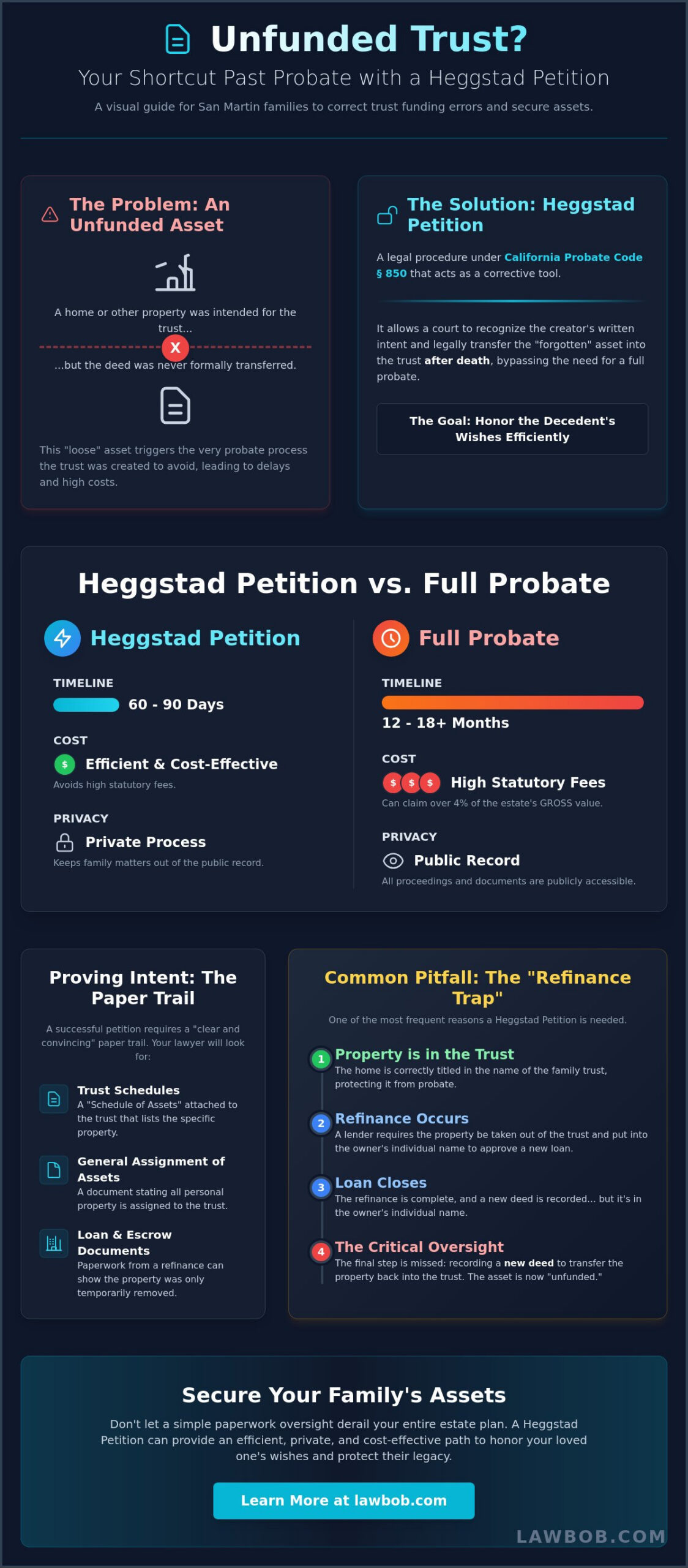
We understand the stress of navigating California’s complex court system while you’re still grieving. You likely want to avoid the 12 to 18 month delays and the high statutory fees that can claim over 4% of an estate’s gross value. This guide will show you how to use a Heggstad Petition to move unfunded assets into a trust efficiently. We’ll explain how this process can often be completed in about 60 days; this provides a path to secure a court order that bypasses the public probate record and honors the decedent’s original wishes.
Key Takeaways
- Learn how California Probate Code Section 850 serves as a legal “correction” to fund a trust after death, provided there is clear written evidence of the decedent’s intent.
- Identify common pitfalls like the “refinance trap,” where San Martin properties are removed from a trust for a loan and accidentally left in an individual’s name.
- Discover why working with a Heggstad petition lawyer San Martin can resolve title issues in as little as 60 to 90 days, compared to the much longer probate timeline.
- Understand the essential “paper trail” required by the Santa Clara County Superior Court, including trust schedules and general assignments of assets.
- Gain strategic insight into whether a Heggstad Petition or a Spousal Property Petition offers the most efficient path for your specific trust administration needs.
What is a Heggstad Petition and How Does it Work in San Martin?
A Heggstad Petition is a specific legal procedure under California Probate Code Section 850. It allows a successor trustee to ask the court to “fund” a trust after the creator has already passed away. Essentially, it’s a corrective tool used when an asset, like a family home or a parcel of land, was intended to be in a trust but the formal title transfer never happened. For families dealing with high-value agricultural or residential properties in San Martin, this petition is often the only way to avoid a full, year-long probate process.
The core requirement for a successful petition is providing clear written evidence of the decedent’s intent. It isn’t enough to simply say they wanted the asset in the trust. You must show the court a document, such as a “Schedule of Assets” or a general assignment, that specifically lists the property. Working with a Heggstad petition lawyer San Martin helps ensure that your evidence meets the “clear and convincing” standard required by Santa Clara County judges.
It’s vital to understand the difference between a “Declaration of Trust” and a formal “Deed Transfer.” A Declaration of Trust is the legal language within your trust document stating that you hold certain assets for the benefit of your heirs. A Deed Transfer is the physical document recorded with the Santa Clara County Clerk-Recorder that officially changes the name on the title. When a homeowner signs the trust but forgets to record the deed, the Heggstad Petition bridges that gap by asking the court to recognize the intent as legally binding.
The Landmark Case: Estate of Heggstad (1993)
The name for this procedure comes from the 1993 California Court of Appeal case, Estate of Heggstad. In this landmark decision, the court ruled that a written schedule of assets attached to a trust was sufficient to prove the owner’s intent to transfer property, even if a new deed was never recorded. This was a massive shift in California law. It moved the focus from strict technicalities to the actual wishes of the person who created the trust. Today, this precedent has evolved to help families recover not just real estate, but also “forgotten” bank accounts and personal property.
Why “Funding” Your Trust is the Missing Step
Trust funding is the process of changing the titles and beneficiary designations on your assets to match your trust’s name. It’s the most common step people miss. San Martin homeowners often fail to complete this because they buy new property after the trust is created or they temporarily remove a home from the trust to qualify for a refinance. While a “Pour-over Will” acts as a secondary safety net by catching these loose assets, it usually requires a probate court’s involvement. A Heggstad Petition allows a Heggstad petition lawyer San Martin to bypass that lengthy probate and move the assets directly where they belong.
Common Scenarios Requiring a Heggstad Petition in Santa Clara County
Even with the best intentions, assets frequently slip through the cracks of a comprehensive estate plan. In San Martin, where property values are substantial, these omissions can lead to costly probate delays for grieving families. Understanding why these gaps occur is the first step in determining if you need a California Probate Code § 850 petition to rectify the title and honor your loved one’s wishes.
The Refinance Trap: A Silicon Valley Epidemic
This is perhaps the most frequent scenario we encounter. During periods of low interest rates, many homeowners in the San Martin area choose to refinance their mortgages. Lenders often require that a property be moved out of a trust and back into the owner’s personal name to finalize the loan. Once the loan closes, the owner receives a “Grant Deed” putting the house back in their name. If they don’t immediately record a new deed putting it back into the trust, the property remains “unfunded.” You can often find the necessary evidence of intent within the old loan applications or escrow instructions that clearly state the trust’s existence.
If you find yourself in this situation, a Heggstad petition lawyer San Martin can help you compile the specific documentation needed to prove to the court that the property was only removed for financing purposes. This evidence is crucial for a successful petition.
Business Interests and Personal Property
It isn’t just real estate that gets left behind. Many San Martin residents hold interests in LLCs or closely held family businesses. If these interests aren’t formally assigned to the trust, they may be stuck in probate. The same applies to high-value personal property like specialized farm equipment, classic cars, or art collections. The “General Assignment of Assets” is a critical document here; it serves as a blanket statement that the decedent intended all their belongings to be part of the trust. Proving this intent requires a methodical review of all business and personal records.
Other common scenarios include:
- Newly Acquired Assets: Buying a vacation home or additional acreage in Morgan Hill and titling it individually by mistake.
- Incomplete Transfers: Starting the paperwork and signing the deed but passing away before it reaches the Santa Clara County Clerk-Recorder’s office.
- The “Forgotten” Brokerage Account: Opening a new investment portfolio years after the trust was established and forgetting to use the trust’s tax ID or title.
Identifying these “loose” assets early is vital for a smooth transition. If you are unsure whether an asset was properly titled, you might consider seeking trustee advisory services to review the estate’s current standing and avoid future complications.
Heggstad Petition vs. Full Probate: A 2026 Comparison
Choosing between a Heggstad Petition and full probate is often a matter of efficiency and cost. A Heggstad Petition acts as a surgical legal correction. It addresses specific title issues without pulling the entire estate into the court’s oversight. In contrast, full probate is a comprehensive administrative process that typically lasts between 12 and 18 months. By consulting a Heggstad petition lawyer San Martin, you can often secure a court order in just 60 to 90 days, allowing you to move forward with trust administration much sooner.
Privacy is another major differentiator. Full probate cases are public records. This means anyone can view the Inventory and Appraisal, which lists every asset and its value. A Heggstad Petition is much more discreet. It focuses on the specific asset in question rather than exposing the entire estate to public scrutiny. You also avoid the heavy administrative burden of publishing notices to creditors or filing complex court accountings, which are mandatory in standard probate cases.
Calculating the Financial Savings
The financial impact of choosing the right path is substantial. In California, statutory attorney and executor fees for probate are calculated based on the gross value of the estate, not the net value. For a San Martin home valued at $1,000,000, the statutory fees alone can exceed $46,000. These fees are set by California Probate Code Section 10810 at 4% of the first $100,000, 3% of the next $100,000, and 2% of the next $800,000.
A Heggstad Petition is significantly more cost-effective because it typically involves predictable legal fees rather than a percentage of the property’s value. As of January 1, 2026, the filing fee for a first-filed petition in Santa Clara County is approximately $435 to $550. When you compare this to the tens of thousands of dollars lost to statutory probate fees, the Heggstad route is the clear choice for protecting the family’s inheritance.
The Emotional Benefit of a Speedier Resolution
Speed offers more than just financial savings; it provides emotional relief. Grieving beneficiaries shouldn’t have to endure a year of legal uncertainty. A quick resolution allows you to sell real estate promptly if the market is shifting or distribute assets to those who need them. You also avoid the repetitive “Probate Examiner” back-and-forth that often plagues full administrations. Working with a Heggstad petition lawyer San Martin helps you bypass these hurdles, replacing court delays with a sense of transparency and self-assurance.
Filing Your Petition in the Santa Clara County Superior Court
Successfully navigating the court system requires a methodical approach. You aren’t just submitting paperwork; you’re presenting a formal request for the court to honor your family member’s true intentions. For San Martin residents, this process takes place at the Downtown Superior Court, located at 191 North First Street in San Jose. Following a specific set of steps ensures your petition moves through the system without unnecessary friction.
- Step 1: Gather the Evidence. Collect the original trust document, all amendments, and the “Schedule of Assets.” These documents form the legal foundation of your case.
- Step 2: Draft the Petition. Your filing must include a precise legal description of the property. A simple street address is insufficient for a court order; you need the assessor’s parcel number and the full metes and bounds description found on the last recorded deed.
- Step 3: File the Paperwork. Once drafted, the petition is filed with the Santa Clara County probate department. As of early 2026, the filing fee for a first-filed petition typically ranges from $435 to $550.
- Step 4: Serve Legal Notice. California law requires you to provide at least 30 days’ notice of the hearing to all heirs and interested parties. This is a strict requirement that cannot be skipped.
- Step 5: Obtain the Court Order. After a successful hearing, the judge signs a decree. You then record this document with the county to officially transfer the title into the trust.
Local Rules and the Role of the Probate Examiner
The Santa Clara County Probate Examiner plays a vital role in your case. Before a judge ever sees your file, the examiner reviews it for “defects.” These are common errors like missing signatures, improper notice, or vague property descriptions. If the examiner finds issues, they’ll issue “probate notes” that you must address before the hearing date. A Heggstad petition lawyer San Martin understands these local nuances and can prepare a clean “Proposed Order” to ensure the judge has everything they need to approve your request immediately.
Proving “Clear and Convincing” Evidence
To win a Heggstad case, you must meet a high evidentiary standard. Judges look for clear proof that the decedent intended the asset to be in the trust. This proof often resides in “Schedule A” or “Attachment 1” of the original trust. If these documents are unclear, you may need supporting affidavits from family members or the drafting attorney. Using digital evidence, such as electronic metadata from trust drafts, is an increasing trend in 2026 that can help establish this intent. If you’re feeling overwhelmed by the technical requirements of the court, requesting professional help for Heggstad Petitions can provide the clarity and security you need to move forward.
How Robert P. Bergman Assists San Martin Successor Trustees
Dealing with a “loose” asset after a loved one passes away is an inherently stressful experience. A Heggstad petition lawyer San Martin provides more than just legal forms; they offer a roadmap for recovery and peace of mind. Robert P. Bergman acts as a mentor for successor trustees, ensuring that every step of the administration process is handled with precision. By conducting an expert review of your trust documents, we identify the most efficient legal path to secure the family’s legacy. As a State Bar Certified Specialist in Estate Planning, Trust, and Probate Law, Bob brings a level of specialized expertise that general practitioners simply cannot match.
Sometimes, a Heggstad Petition isn’t the only option available to your family. We provide strategic advice on whether a Spousal Property Petition might be a faster or more appropriate choice depending on how the title was held. Our goal is to handle all court filings and notices correctly the first time to avoid the “defects” that often plague unrepresented filings in Santa Clara County. We focus exclusively on non-litigated solutions. This approach keeps the process away from contested battles and helps maintain family harmony during a difficult time. We’re here to solve title problems, not create new legal conflicts.
A Mentor-Led Approach to Trust Administration
If you feel overwhelmed by your duties as a trustee, you aren’t alone. We provide direct instructional guidance to help you understand your responsibilities. We believe in transparency, which is why we offer predictable pricing models for Heggstad petitions in San Martin. This financial predictability reduces the anxiety of variable billing and lets you focus on your family. Beyond solving the immediate title issue, we focus on education. We want to help your family prevent future estate planning errors so the next generation doesn’t face these same hurdles. Think of us as a guardian for your family’s long-term financial security.
Protecting San Martin Families Since 1980
With decades of experience navigating the Santa Clara County court system, we understand the specific expectations of local judges and probate examiners. Since 1980, we’ve served as a reliable resource for local assets, providing a sense of security and peace of mind during difficult transitions. This seasoned perspective is invaluable when you’re managing complex properties, agricultural land, or high-value business interests. You don’t have to navigate this complex transition without support. Please schedule a consultation with Robert P. Bergman to discuss your Heggstad Petition and learn how we can help you avoid the probate process.
Secure Your Family’s Legacy without Probate Delays
Moving “forgotten” assets into a trust doesn’t have to be a multi-year ordeal. By utilizing a Heggstad Petition, you can bypass the public probate record and protect the estate from high statutory fees. This legal correction honors the decedent’s true intent while providing a significantly faster distribution to beneficiaries. Working with a Heggstad petition lawyer San Martin ensures that your filing meets the strict evidentiary standards of the Santa Clara County Superior Court. Robert P. Bergman is a Certified Specialist in Estate Planning, Trust, and Probate Law who has served the community since 1980. Our firm utilizes fixed-cost models to provide financial predictability during an otherwise uncertain time.
You don’t have to navigate this complex process alone. We’re here to provide the steady hand and professional authority needed to resolve these title issues quickly and efficiently. Schedule Your Heggstad Petition Review with Robert P. Bergman. Take the first step toward a simpler, more secure transition for your family.
Frequently Asked Questions
How much does a Heggstad Petition cost in Santa Clara County?
The court filing fee for a Heggstad Petition in Santa Clara County is approximately $435 to $550 as of 2026. This is a significant saving compared to full probate, where statutory fees are based on a percentage of the gross estate value. While legal fees for the petition vary, they are typically predictable and much lower than the thousands of dollars required for a full administration. This financial predictability helps reduce the stress of managing a loved one’s estate.
What evidence is needed to win a Heggstad Petition?
You must provide clear and convincing evidence that the decedent intended the asset to be part of their trust. This usually includes a written “Schedule of Assets” or a “General Assignment” document signed by the trust creator. Recently, courts have even begun accepting digital evidence, such as electronic metadata from trust drafts, to establish this intent when a physical deed is missing. This evidence is crucial for a successful outcome in the San Jose courts.
Can I file a Heggstad Petition if there is no “Schedule of Assets”?
Yes, you can still file even without a formal “Schedule A.” A Heggstad petition lawyer San Martin can help you identify other forms of written evidence, such as a “General Assignment of Assets” or specific mentions of the property within the trust’s text. The goal is to prove the owner’s intent to hold the property as a trustee, even if the formal title transfer didn’t occur. This ensures paperwork omissions don’t derail an entire estate plan.
How long does the Heggstad process take in San Jose courts?
The Heggstad process is generally completed within 60 to 90 days in the Santa Clara County Superior Court. This is considerably faster than a full probate, which often stretches between 12 and 18 months. Once the judge signs the court order, you can immediately record it to finalize the title transfer and proceed with distributing the assets to the named beneficiaries. This speed is vital for families who need to sell real estate or settle debts quickly.
Do I have to go to court for a Heggstad Petition hearing?
In most cases, you do not need to personally attend the hearing if you are represented by a Heggstad petition lawyer San Martin. Your attorney typically handles the presentation of evidence and addresses any questions from the probate examiner or the judge. This allows you to focus on your family while the legal technicalities are managed professionally in the Downtown San Jose courthouse. Most petitions are resolved through these formal appearances without requiring the trustee’s physical presence.
What happens if the Heggstad Petition is denied by the judge?
If a judge denies the petition, the asset will likely have to go through the formal probate process. This usually happens if the evidence of intent is deemed insufficient or if there are competing claims to the property. Because a denial leads to longer delays and higher costs, it’s vital to ensure your initial filing is comprehensive and addresses all local court requirements. Seeking professional guidance early in the process helps minimize the risk of a costly denial.
Can a Heggstad Petition be used for bank accounts and stocks?
Yes, this procedure applies to bank accounts, brokerage portfolios, and LLC interests just as it does to real estate. If a decedent opened a new account but forgot to title it in the name of their trust, a petition under Probate Code Section 850 can move that “loose” asset into the trust. This prevents the account from being frozen or subjected to the public probate process. It’s an effective way to consolidate all assets under the trust’s umbrella.
Is a Heggstad Petition public record like a probate case?
While court filings are technically public records, a Heggstad Petition is much less intrusive than a full probate case. A standard probate requires a public filing of the complete “Inventory and Appraisal,” which lists every asset in the estate. A petition focuses only on the specific “forgotten” asset, keeping the rest of your trust’s private details and distribution plans out of the public eye. This approach maintains a higher level of privacy for the family’s financial affairs.

Article by
Robert P. Bergman
Bob Bergman has been a Board Certified Specialist in Estate Planning, Trust and Probate Law since 2011, as certified by the California State Bar Board of Legal Specialization. For over 40 years, Bob has assisted families in Santa Clara County and the greater San Francisco Bay Area with estate planning, trust administration, and specialty court petitions involving trusts. Bob is friendly, very approachable, and believes in explaining complex legal topics in clear ordinary language so that his clients understand exactly what they're doing and why they're doing it.
Disclaimer
This article is for informational purposes only. Nothing in this article is intended to replace legal advice from a competent attorney. Nobody should rely on information in this article in making legal decisions without such consultation.