
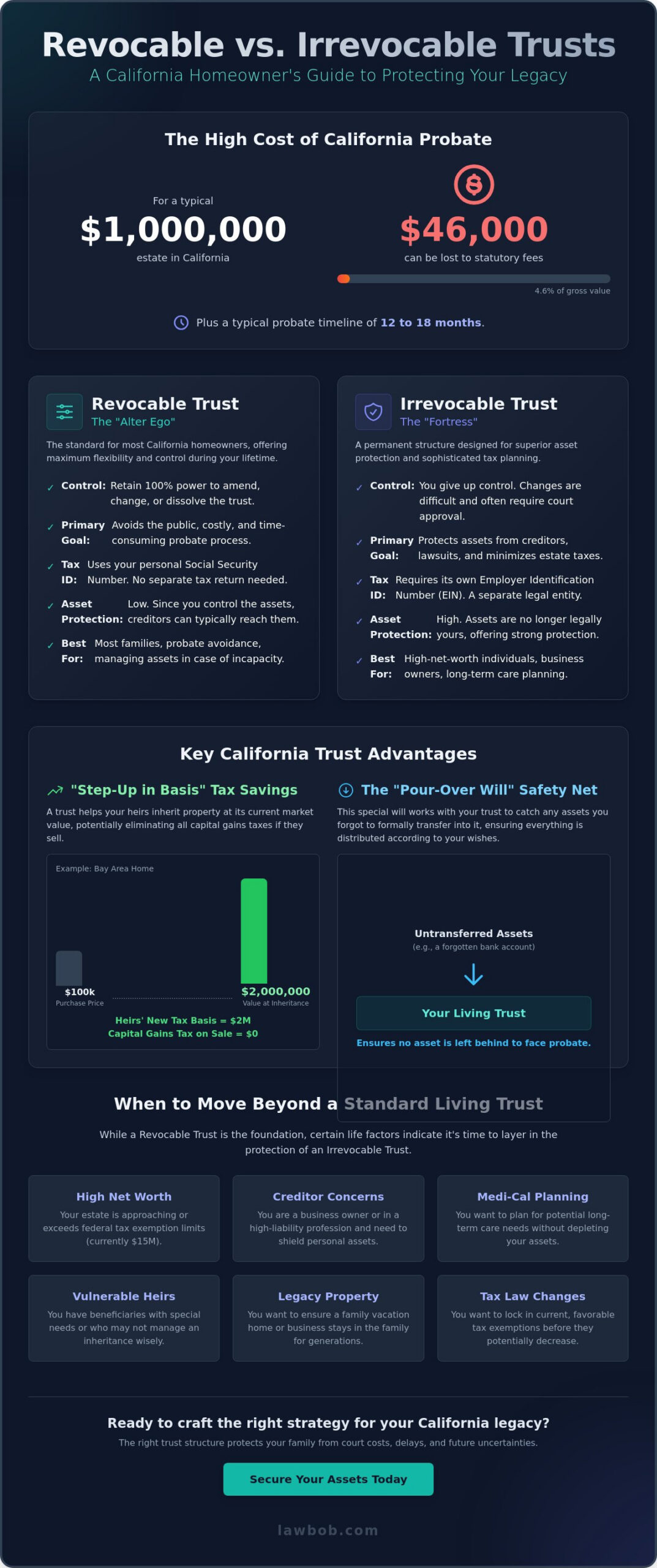
Did you know that a $1 million estate in California can lose approximately $46,000 just to statutory probate fees before your heirs see a single cent? It’s a staggering figure that explains why so many families feel anxious about the state’s 12 to 18 month probate timeline. Deciding between a revocable vs irrevocable trust California is the most critical step you can take to protect your Silicon Valley assets and ensure your legacy remains intact. You likely want to maintain control over your property while also minimizing the future burden on your loved ones.
We understand that navigating these legal choices can feel overwhelming, especially with the “One Big Beautiful Bill Act” making the $15 million federal tax exemption permanent. This guide will give you the clarity you need to move forward with confidence. You’ll learn how to shield your heirs from costly court processes, manage the 2026 Medi-Cal asset limits, and decide which trust structure aligns with your specific goals for flexibility and fortification.
Key Takeaways
- Understand how to balance your need for lifetime flexibility with the long-term goal of legacy fortification for your family.
- Learn the specific steps to keep your California home out of the public probate courts, avoiding costly delays and statutory fees.
- Compare a revocable vs irrevocable trust California to determine which structure best protects your assets under the current $15 million tax exemption.
- Identify the net worth thresholds and lifestyle factors that indicate when it’s time to move beyond a standard living trust.
- Discover how to navigate complex state-specific rules, including Proposition 19, to minimize property tax reassessment for your heirs.
Understanding the Core Differences: Control vs. Protection
Choosing between a revocable vs irrevocable trust California requires you to weigh your desire for lifetime flexibility against your need for long-term security. Every trust functions as a legal arrangement where one party holds property for the benefit of another. To grasp the mechanics, you must understand three specific roles. The Grantor is the person who creates the trust and provides the assets. The Trustee is the individual or entity responsible for managing those assets. The Beneficiary is the person who eventually receives the assets or the income they generate. Understanding Trusts reveals that while these roles exist in every trust, the level of control the Grantor retains varies wildly between revocable and irrevocable structures.
A central concept in this decision is the difference between “tax ownership” and “legal ownership.” In a revocable setup, you might transfer legal title to the trust, but the IRS still considers you the tax owner because you haven’t truly given the property away. Conversely, an irrevocable trust often shifts both legal and tax ownership away from your personal estate. This distinction determines how your assets are taxed and how well they are protected from outside threats.
The Power to Change: Revocability Explained
A Revocable Living Trust is designed to be your “alter ego.” As the Grantor, you retain the absolute right to amend, restate, or entirely dissolve the trust at any time. This flexibility is why it remains the gold standard for California homeowners. Because you maintain total control, the trust uses your Social Security number for tax reporting. There is no need for a separate tax return while you are alive. If you face incapacity or pass away, the transition of control to your successor trustee is seamless. This bypasses the California probate courts entirely, keeping your private family matters out of the public record.
The Fortress: Why Irrevocability is Permanent
Irrevocable trusts function as a legal “fortress.” When you move assets into this type of trust, you are effectively making a permanent gift to a separate legal entity. You generally cannot take those assets back or change the terms once the documents are signed. This permanence is exactly what provides superior asset protection; if you don’t own the assets, your creditors cannot reach them. Because the trust is a distinct legal “person,” it requires its own Employer Identification Number (EIN) from the IRS. While California law is strict regarding modifications, limited changes can sometimes be made through specific court petitions or the unanimous consent of all beneficiaries, though these processes are complex and often costly.
By understanding these core differences, you can better evaluate which strategy fits your net worth and family goals. Most families start with a revocable trust for probate avoidance, while high-net-worth individuals often layer in irrevocable trusts to lock in tax exemptions or provide specialized protection for vulnerable heirs.
The Revocable Living Trust: The California Homeowner’s Standard
For most families in the Bay Area, a Revocable Living Trust serves as the cornerstone of their estate plan. It is particularly vital because of California’s unique probate laws and high real estate values. If you own a home in San Jose or surrounding Silicon Valley cities, your property value almost certainly exceeds the state’s probate thresholds. Without a trust, your estate faces a public, court-supervised process that is notoriously expensive and slow. When evaluating a revocable vs irrevocable trust California, homeowners typically find that the revocable option provides the best balance of probate avoidance and personal control.
Beyond simple asset transfer, this trust maintains your “Step-up in Basis” for capital gains tax benefits. In California, community property assets receive a double step-up in basis when the first spouse passes away. This means if you bought a home decades ago for $100,000 and it is now worth $2 million, your heirs can sell it at the current market value without paying massive capital gains taxes. To ensure no assets are left behind, we pair this trust with a “Pour-Over Will.” This document acts as a safety net, catching any assets you forgot to retitle and “pouring” them into your trust after death.
Avoiding the Costly California Probate Process
California’s statutory probate fees are calculated based on the gross value of the estate, not the net value. For a $1 million estate, the combined mandatory fees for the attorney and executor are approximately $46,000. This money comes directly out of your heirs’ inheritance. Additionally, probate in Santa Clara County typically takes 12 to 18 months to complete. During this time, your family may struggle to access funds or manage property. Forbes on Trust Strategies highlights that privacy is another major factor; while a Will becomes a public record that anyone can search, a trust remains a private family document.
Planning for Incapacity in Silicon Valley
A Revocable Living Trust does more than manage your death; it manages your life. If you become unable to handle your affairs due to illness or injury, your successor trustee can step in immediately to manage your Silicon Valley assets. This prevents the need for a “living probate,” also known as a court-supervised conservatorship. These court proceedings are public, stressful, and very expensive. By integrating your trust with a Durable Power of Attorney and an Advance Health Care Directive, you create a comprehensive shield for your well-being. If you are ready to secure your family’s future, establishing Revocable Living Trusts is a practical first step toward total peace of mind.
The Irrevocable Trust: Asset Protection and the 2026 Tax Landscape
While a revocable trust serves as a flexible foundation for most California families, an irrevocable trust functions as a permanent legal fortress. The decision to move from a revocable vs irrevocable trust California usually happens when your goals shift from simple probate avoidance to aggressive asset protection or sophisticated tax planning. By transferring assets into an irrevocable trust, you are effectively removing them from your personal estate. This move shields those assets from future lawsuits, creditors, and professional liability claims, which is a significant concern for Silicon Valley entrepreneurs and medical professionals.
There are several specialized structures used to achieve these goals. A Spousal Lifetime Access Trust (SLAT) allows one spouse to benefit from assets while removing them from the taxable estate. An Irrevocable Life Insurance Trust (ILIT) keeps insurance payouts from being taxed as part of your wealth. For homeowners with high-value property, a Qualified Personal Residence Trust (QPRT) can transfer a home to heirs at a reduced gift tax value. These tools require a permanent commitment, but they offer a level of security that a standard living trust cannot match.
Navigating the 2026 Estate Tax Exemption
In years past, many feared a “tax cliff” where exemptions would drop significantly. However, the “One Big Beautiful Bill Act” of 2025 made the higher federal estate tax exemption permanent. For 2026, the individual exemption stands at $15 million, while married couples can protect up to $30 million. Even with these high limits, 2026 remains a “use it” year for high-net-worth families. By transferring assets into an irrevocable trust now, you lock in the $15 million exemption and ensure that all future appreciation on those assets, such as rapidly growing tech stocks or San Jose real estate, occurs outside of your taxable estate. This strategy effectively freezes the value of your estate for tax purposes.
Medi-Cal Planning and Long-Term Care
Irrevocable trusts also play a vital role in qualifying for long-term care benefits. As of January 1, 2026, California has reinstated asset limits for Medi-Cal eligibility. The current limit for an individual is $130,000 in countable assets, while a married couple is limited to $195,000. To meet these requirements without depleting your hard-earned savings, you can use a specific type of irrevocable trust to hold your assets. Because California enforces a “5-year look-back” rule for certain transfers, starting this process early is essential. This planning protects the family home from Medi-Cal estate recovery, ensuring your property passes to your children rather than being claimed by the state to offset care costs.
If you are concerned about protecting your wealth from future liabilities, exploring Asset Protection Planning can help you determine if an irrevocable structure is right for your family’s needs.
Revocable vs. Irrevocable: A Decision Matrix for 2026
Deciding between a revocable vs irrevocable trust California usually comes down to four specific factors: control, tax strategy, asset protection, and cost. While a revocable trust offers maximum flexibility, an irrevocable trust provides a higher level of defense against outside threats. Most families in Silicon Valley find that a revocable trust meets their primary goal of probate avoidance. However, as your net worth grows or your professional liability increases, the shift toward an irrevocable structure becomes a strategic necessity rather than just an option.
Many high-net-worth individuals choose a “hybrid” approach. They maintain a Revocable Living Trust for their primary San Jose residence and daily bank accounts to ensure they keep total control over their lifestyle. Simultaneously, they establish one or more irrevocable trusts to hold specific assets like life insurance policies or rapidly appreciating tech stocks. This tiered strategy allows you to avoid the $46,000 in statutory probate fees on a million-dollar estate while also locking in the current $15 million federal gift tax exemption provided by the “One Big Beautiful Bill Act.”
You must weigh these benefits against the primary danger of irrevocable trusts: the loss of direct access. Once you transfer property into an irrevocable structure, you generally cannot pull those funds back out for personal use or change the beneficiaries because you no longer legally own the assets. If you are serving as a trustee and feel overwhelmed by these complexities, our Trustee Advisory Services can provide the professional guidance needed to manage these distinct legal entities correctly.
When to Choose a Revocable Trust
- San Jose Homeowners: Your main goal is to keep your primary residence out of the Santa Clara County probate courts while maintaining the right to sell or refinance the property at any time.
- Estates Under $15 Million: Your total assets are well below the federal tax exemption, and your primary concern is the seamless transfer of property to heirs rather than estate tax reduction.
- Frequent Changes: You anticipate changing your mind about who receives what, or you plan to acquire and sell assets frequently throughout your retirement.
When to Choose an Irrevocable Trust
- High-Risk Professionals: You are a surgeon, real estate developer, or business owner in a litigious field and need to shield your wealth from potential future lawsuits.
- Approaching Tax Limits: Your estate is nearing the $15 million individual (or $30 million couple) exemption, and you want to remove future appreciation from your taxable estate now.
- Special Needs Protection: You have an heir with a disability who relies on government benefits, requiring a specialized structure to provide for their care without disqualifying them from essential aid.
Crafting Your California Legacy with the Law Offices of Robert P. Bergman
Choosing between a revocable vs irrevocable trust California is more than a legal transaction. It’s a strategic decision for your family’s future. At the Law Offices of Robert P. Bergman, we bring over 40 years of local experience to every estate plan we draft. Robert P. Bergman is a State Bar of California Certified Specialist in Estate Planning, Trust, and Probate Law. This distinction is rare. It signals a level of mastery and dedication that general practitioners simply cannot match. Our firm focuses exclusively on non-litigated matters. This means our primary goal is to build robust, clear, and defensive documents that prevent family conflict from ever reaching a courtroom. We also believe in financial transparency. Our fixed-fee model ensures you know exactly what your comprehensive estate plan will cost from the start, removing the stress of variable billing.
Deciding between a revocable vs irrevocable trust California requires professional insight into how these structures interact with your specific assets. We don’t just provide templates. We provide a customized framework designed to withstand the complexities of the California Probate Code. Whether you are protecting a family home or managing a complex portfolio of Silicon Valley tech stocks, we ensure your plan is built on a foundation of precision and reliability.
A Mentor-Based Approach to Planning
We view our role as mentors rather than just document preparers. We guide Silicon Valley families through the technical nuances of their asset mix, from stock options to high-value real estate. A common pitfall we see is a trust that hasn’t been “funded.” If your assets aren’t properly retitled into the trust’s name, your heirs might still end up in court filing Heggstad Petitions to fix the oversight. We work with you to ensure every piece of property is correctly positioned. Our support continues long after the documents are signed through our Trust Administration and Trustee Advisory Services.
Next Steps for Your Security
Your security begins with a personalized strategy. A generic Will is rarely enough to protect a Silicon Valley estate from the high costs and long delays of probate. Moving to a robust California trust provides the defensive shield your family deserves. During a personal consultation, we evaluate your specific asset mix to determine if a revocable or irrevocable structure aligns with your 2026 tax goals. We help you transition from uncertainty to a place of self-assurance. Don’t leave your legacy to chance or the public court system. Schedule your consultation with Robert P. Bergman today to start building a plan rooted in precision and peace of mind.
Take Control of Your Family’s Future Today
You now have a clearer understanding of the choice between a revocable vs irrevocable trust California. Whether you prioritize the absolute flexibility of a living trust to avoid probate or the robust asset protection of an irrevocable structure, the decision you make today prevents years of court delays for your loved ones. You’ve learned how to shield your home from public record and how to leverage permanent tax exemptions that protect your hard-earned wealth. These steps replace uncertainty with a sense of self-assurance.
Planning for the unexpected doesn’t have to be overwhelming. Since 1980, our firm has helped families navigate these complex legal waters with a steady hand and predictable, fixed-cost service models. As a Certified Specialist in Estate Planning, Trust, and Probate Law, Robert P. Bergman provides the specialized expertise required to build a defensive, reliable legacy that withstands future challenges.
Secure your family’s future with a Certified Estate Planning Specialist—Contact Robert P. Bergman. You’ve worked hard to build your life in Silicon Valley; let’s work together to ensure it stays protected for the next generation.
Frequently Asked Questions
Can I change a revocable trust into an irrevocable trust in California?
Yes, you can effectively change your strategy by moving assets from your revocable trust into a new irrevocable one. While you don’t technically “convert” the document itself, you create a new legal entity with different rules to achieve specific tax or protection goals. Additionally, a revocable trust automatically becomes irrevocable in California the moment the grantor passes away, locking in the distribution instructions for the beneficiaries.
Does a revocable living trust protect my assets from lawsuits in San Jose?
No, a revocable trust does not provide any protection from creditors or lawsuits. Because you retain the power to revoke the trust and take the assets back at any time, the law treats those assets as if you still own them personally. If a plaintiff wins a judgment against you in Santa Clara County, they can reach into your revocable trust to satisfy that debt just as easily as a personal bank account.
What happens to my revocable trust after I die?
Your trust becomes a permanent, irrevocable entity immediately upon your death. Your successor trustee takes over management duties without needing permission from a probate judge. They use the trust’s assets to pay your final expenses and then distribute the remaining property to your heirs according to your exact instructions. This transition happens privately and much faster than the 12 to 18 month timeline required for California probate.
Why would someone choose an irrevocable trust if they lose control of the assets?
The primary reason to choose an irrevocable trust is to gain defensive benefits you can’t get elsewhere. When deciding between a revocable vs irrevocable trust California, you might give up control to shield your wealth from professional liability or to qualify for Medi-Cal long-term care benefits. It’s a strategic trade-off where you sacrifice the ability to change your mind in exchange for permanent security and significant estate tax savings for your heirs.
Do I need an irrevocable trust to avoid the 2026 estate tax changes?
For most families, the answer is no because the $15 million individual exemption is now permanent under the “One Big Beautiful Bill Act.” However, high-net-worth individuals still use irrevocable trusts to “freeze” the value of their growing assets. By moving property into an irrevocable trust now, you ensure that all future appreciation on your Silicon Valley real estate or tech stocks happens outside of your taxable estate, potentially saving your children millions in future taxes.
Can a nursing home take my house if it is in a revocable trust?
Yes, a house held in a revocable trust is considered a “countable asset” when California determines your eligibility for Medi-Cal long-term care. Since you have the power to take the house out of the trust, the state expects you to use that equity to pay for your nursing home costs. To protect your primary residence from being claimed by the state after you pass away, you would generally need a specialized irrevocable trust structure.
What is the “Step-up in Basis” and why does it matter for my California real estate?
A step-up in basis resets the value of an inherited asset to its current market price at the time of your death. This is a massive benefit for California homeowners whose property values have skyrocketed over the last few decades. If your children inherit your home through a trust, they can sell it immediately and pay zero capital gains tax, even if the property grew in value by millions of dollars since you originally purchased it.
How much does it cost to set up a trust in the San Jose area?
The cost of your estate plan depends entirely on the complexity of your family situation and the types of assets you own. We avoid the stress of hourly billing by using a transparent, fixed-fee model for our comprehensive plans. This ensures you receive a custom-tailored strategy that includes the trust, pour-over will, and powers of attorney without any surprise expenses. Investing in a professionally drafted plan is much more affordable than the $46,000 in statutory fees a $1 million estate typically loses to probate.

Article by
Robert P. Bergman
Bob Bergman has been a Board Certified Specialist in Estate Planning, Trust and Probate Law since 2011, as certified by the California State Bar Board of Legal Specialization. For over 40 years, Bob has assisted families in Santa Clara County and the greater San Francisco Bay Area with estate planning, trust administration, and specialty court petitions involving trusts. Bob is friendly, very approachable, and believes in explaining complex legal topics in clear ordinary language so that his clients understand exactly what they're doing and why they're doing it.
Disclaimer
This article is for informational purposes only. Nothing in this article is intended to replace legal advice from a competent attorney. Nobody should rely on information in this article in making legal decisions without such consultation.